
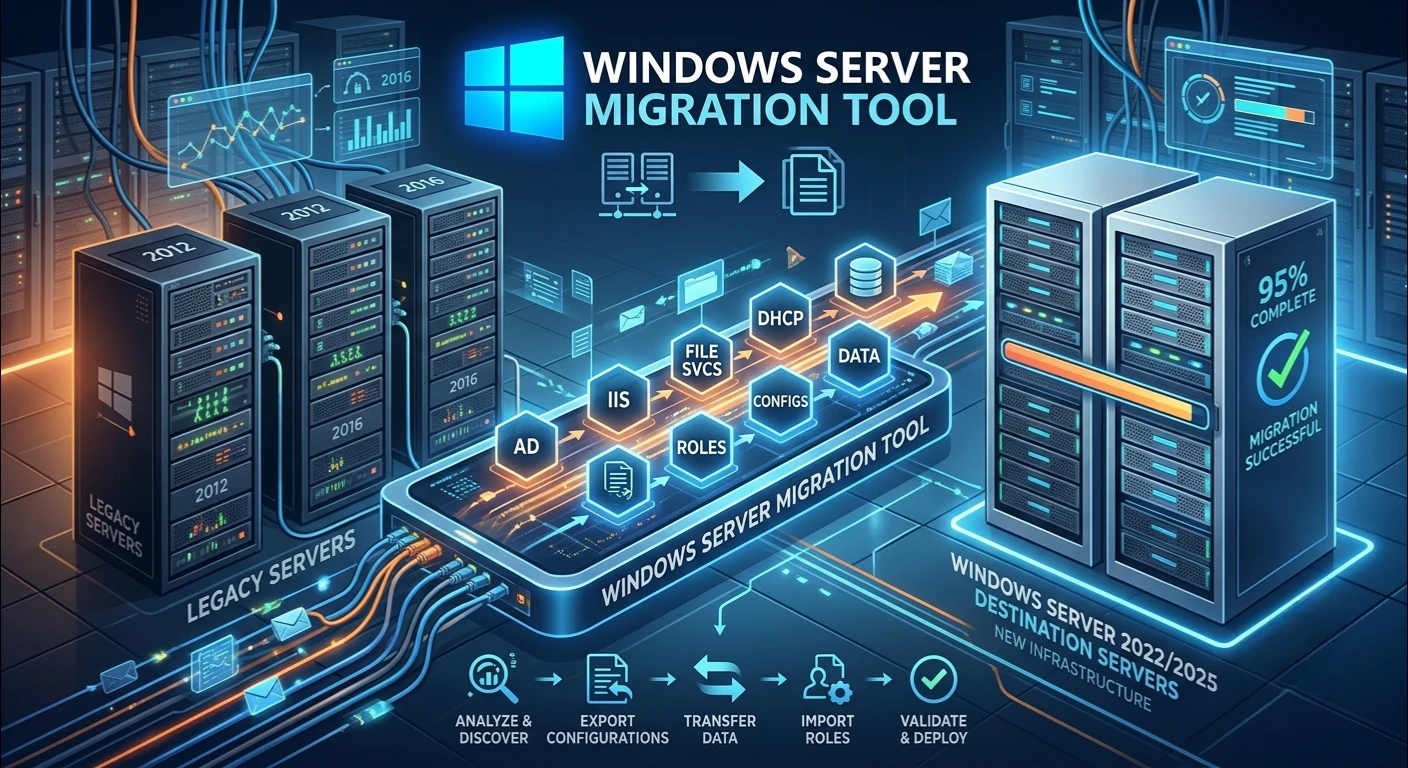
Organizations often find that they have to upgrade or migrate to newer systems in today’s rapid pace of change in the IT industry. That’s where the Windows Server Migration Tool is so crucial. You can move roles, features, data and configuration between servers without having to start from scratch.
This tool can help you upgrade your older Windows Server version or migrate your workloads to a new environment without downtime, security risks, or hassle.
The windows server migration tool is popular in the enterprise, data center, and small business because of its data continuity and data integrity.
Windows Server Migration Tool is?
Windows Server Migration Tool is a tool that Microsoft engineers have created and released to assist administrators in moving their server roles, system configuration, and data between Windows Server machines.
It provides support for migrations between different operating systems and versions, including Windows Server 2016, 2019, and 2022, offering flexibility in today’s evolving infrastructure landscape.
This tool helps in:
- You can move server roles and features. Server roles and features can be moved.
- Transferring system settings
- Move data and files to other system(s).
- Role continuity between servers
Simplestly, it is actually a server-to-server migration remedy that lessens manual effort and configuration mistakes.
Windows Server Migration Tool is Important
Migration of the server is a crucial task in IT management. If not, it can result in data loss, downtime, and disruption of services if these tools are not used properly. The Windows Server migration utility can overcome these problems by automating the majority of the migration process.
They offer a number of advantages:
1. Reduced Downtime
The tool is designed to help get services moved efficiently without disrupting systems during migration.
2. Data Integrity
It ensures the integrity of file structures, permissions and configurations while migrating to Windows Server.
3. Cost Efficiency
Organizations can recycle the configuration of their existing servers.
4. Smooth Upgrade Path
Enables Windows Server upgrade migration between Windows Server versions 2016, 2019 and 2022.
5. Secure Migration
Provides safe passage of sensitive information and role transfer such as Active Directory and DNS.
Main Features of Windows Server Migration Tools
The Windows Server Migration Tools have several features that are geared towards enterprise level migration tasks.
Server Role Migration
These roles can be migrated:
This is Active Directory Domain Services.
DNS Server
DHCP Server
File Server roles
File and Data Transfer
Seamless folder, permissions and shared resource migration between Windows processes and file server.
System State Migration
With system state migration Windows Server, administrators can move system settings, registry data, and system configurations.
Network Services Migration
Supports migration of network services to Windows Server: DNS and DHCP configuration.
Flexible Deployment
Operates both in the physical and virtual world, accommodating hybrid infrastructure configurations.
Supported Migration Scenarios
The tool is very flexible and can be used to support various migration scenarios:
-
- Legacy Server Migration: Used to upgrade legacy systems to new versions of Windows Server.
- Server-to-Server Migration: Supports one-to-one server-to-server communication. Use Enterprise Server Migration Toolkit.Use Enterprise Server Migration Toolkit. Ideal for large companies with multiple servers.
- Role-Based Migration: Move individual roles, rather than individual servers.
- Data Center Migration: Complimentary applications in enterprise data center upgrade and restructuring.
How Does Windows Server Migration Work?
There are three main stages to the migration process:
Install Migration Tools
Before you begin the migration, install the Windows Server migration tool, Microsoft package, on both the source and destination servers.
The second step involves gathering and exporting data.The source server collects:
- Roles
- Features
- Configuration settings
- User data
This information is then exported securely.
Next, import and configure the file.Now import and configure the file
The data is imported to the destination server and configurations are applied automatically.
This will allow the functionality of the server configuration transfer tool to run smoothly, without manual setup.
Common Migration Types
Active Directory Migration Tool: Used to safely move domain controllers and directory services.
DHCP Migration Tool: Changes DHCP scopes, leases and configurations.
DNS Migration Windows Server: Performs DNS zone / record migration without service interruption.
File Server Migration Windows: Share folders, permissions and files.
System Configuration Migration: Manages registry, policies and system settings.
The Best Practices for Server Migration
These are some best practices to follow when migrating successfully:
1. Plan Before Migration
Always draw in roles, dependencies and network services.
2. Backup Everything
Make a full backup prior to any data transfer Windows Server application.
3. Test Migration First
Test migration in laboratory environment.
4. Monitor Performance
Monitor logs and system performance following migration.
5. Validate Services
Check that all roles such as Active Directory, DNS and DHCP services are operating as expected.
Steps Taken to Overcome Challenges in Server Migration
While migration can be complex, there are times when it can be challenging even with the use of sophisticated tools:
- Any incompatibility problems with versions of the server.
- Large data transfer delays
- Misconfigured roles
- Network interruptions
- Permission mismatches
All of these risks can be greatly diminished, though, with the right Microsoft server migration solution.
Use Cases in Reality IT Environments
A wide variety of uses for the Windows Server migration tool is used in:
- Upgrades to corporate IT infrastructure.
- Educational institutions
- Cloud migration projects
- Data center modernization
- Small business server upgrades
This is particularly useful in applications that require high availability and reliability.
Conclusion
The Windows Server Migration Tool is a must-have tool for today’s IT administrator who must move data, roles and configurations efficiently from server to server. It can make complex migration jobs like Active Directory migration, file server migration, DNS and DHCP transfer and full system state migration easier.
This tool can help organizations ensure seamless transitions, minimal downtime, and secure data management during server upgrades or infrastructure changes.
To sum up, whether you’re upgrading your servers or migrating your entire enterprise, the windows server migration tool offers a sure and efficient choice in each case.