
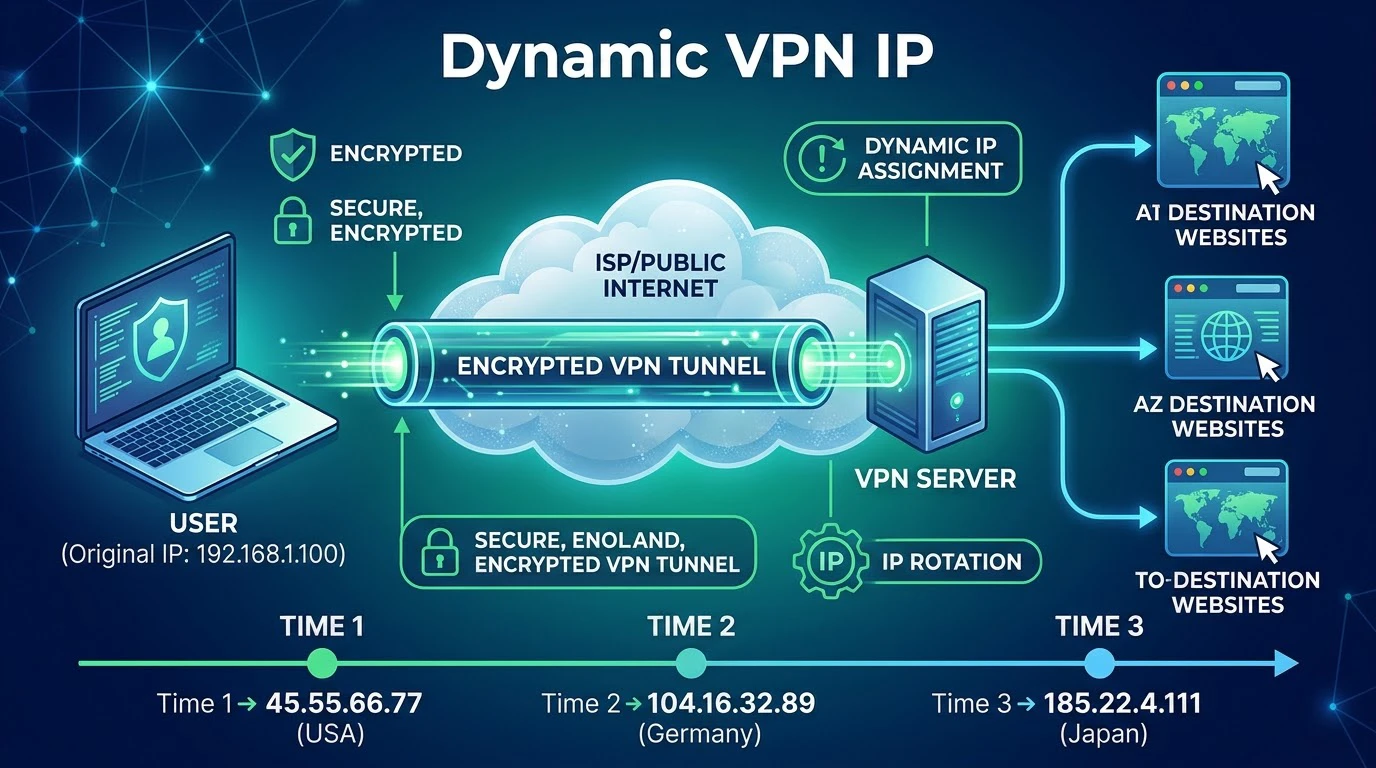
Each time you use the Internet your computer or gadget has a digital “return address. It is visible to websites, advertisers, Internet service providers and sometimes not so friendly people. That address is your IP, and it is more of an indicator of you than you may realise: your approximate location, your provider, and over time a trend of where you go and what you do. One of the easiest and most effective solutions to preventing that IP address from becoming a permanent fingerprint is by using a dynamic VPN IP.
Today, we’ll discuss what a dynamic VPN IP is, the distinction between dynamic and static VPN IPs, who it helps the most, and what steps you can take to find the best provider.
What is Dynamic VPN IP?
A dynamic VPN IP changes over time instead of staying fixed. If you use a VPN, all your traffic goes over one of the provider’s servers, and the websites you visit will show the VPN server’s IP address, not yours. When you use a dynamic VPN IP address, that address may change every time you connect to the VPN, every minute, or perhaps even throughout a particular session.
Imagine you’re going out with a new coat every day. A pedestrian on the street may see someone pass by, but it will be difficult to link both walking sessions with the same individual. The core concept of VPNs with rotating IP addresses is to sever the connection between your sessions and make it more difficult to piece together the online activity into a profile. A large majority of the common VPN services already employ some kind of shared, dynamic addressing. But there are more advanced options available for many providers now, such as automatic IP rotation VPN settings, scheduled VPN changes, and residential, shared, and dedicated dynamic options.
The Process of How a Changing VPN IP Address Works
Upon opening your VPN app, and pressing connect, 3 things occur. Your device establishes an encrypted VPN link with the VPN provider’s server, which tunnels your data with a secure encryption and keeps everyone on your local network and your internet service provider from reading your data. Secondly, the server provides an outgoing IP address from its outgoing IP address pool. Third, your requests use that address instead of your real IP address.
A dynamic IP is a feature that a VPN provides that it gets its IP from a large pool of addresses. The next time you connect, or when a rotation timer runs out, you’re handed a different one. Others take this a step further and automatically switch to different VPN servers (or countries) without you even caring. This is the meaning of the term “IP address rotation” referred to by people. The same as a dynamic IP proxy but with the added security of complete encryption – the majority of proxies do not offer this.
Types of Dynamic VPN IP Addresses
Dynamic addresses aren’t equal. Knowing the different types will help you pick the right one.
Shared (shared) Dynamic Virtual Private Network (VPN) IP Address
This is the most popular choice. There are many users who use the same pool of addresses simultaneously, and it is difficult to isolate any one user. It is perfect for normal privacy and anonymous VPN IP use and is normally the least expensive dynamic VPN service tier.
Ex Exclusive Dynamic VPN IP
You get dedicated IP addresses that rotate on request, reducing the risk of blacklisting while offering the benefits of a changing public IP.
Dynamic VPN IP for Homes
These addresses are on real home Internet connections instead of data centers. Websites are very unlikely to flag or block them since they appear to be just everyday people. However, while they’re more expensive, residential options are popular in the market for research, ad verification, and dynamic VPN for web scraping.
Increased Online Privacy Protection
Even with a fixed address, a VPN IP address can get linked to you over time. That trail is continuously reset by a rotating IP VPN service. It, combined with encryption, is a good basis for privacy protection over the Internet, and it will be very difficult for trackers to form an overall profile of your activities.
Coffee shops, airports and hotels are usually open networks that are easily spied on. Using a VPN connection is encrypted and a dynamic address is another layer, making you a moving target. Changing IP Secure Browsing is particularly useful for on-the-go workers.
Popular Use Cases
Streaming Dynamic VPN
The streaming platforms may refuse to allow the use of well-known VPN IP addresses. If you use more than one VPN IP, if one is blocked you can quickly switch to another one, and continue to watch.
Web Scraping Dynamic VPN
Public data is a good source for data analysts, SEO experts, and researchers. A large volume of requests from a single IP address can be blocked because of rate limits. A reliable VPN IP rotation distributes those requests out through multiple IP addresses, which helps to ensure that projects are running smoothly. Do this in accordance with the terms of service and laws of a site.
Dynamic VPN IP vs Static VPN IP: What to Choose?
With a static VPN IP, the IP address remains unchanged when you log in. It can come in handy when logging into banking sites that mark unusual logins, access to workplace systems that block certain addresses, or services offered. The negative is that a single address can be more easily tracked over time.
A dynamic VPN IP gives you the privacy and flexibility in exchange for that consistency. Most people would prefer a fluctuating VPN IP address while they browse, stream and research, rather than having it fixed. Some providers allow you to switch between both modes, which would be the best of both worlds.
Key Features
It’s not all about cost when selecting a dynamic IP VPN provider. The bottom line.
- It is important to have a no logs policy. But if the provider maintains detailed records of what you do, rotating addresses is not very meaningful. Check for independent audited policies.
- Server coverage is important as well. A good dynamic VPN server network with VPN server locations all over the world provides you more addresses and enhanced speeds.
- Check the rotation controls. The best services have control over rotation via a timer, each rotation, and manually via a single tap. Quickly switch VPN IP addresses to avoid detection.
- The encryption method must be up-to-date, like AES-256 or ChaCha20, and use a secure protocol such as WireGuard or OpenVPN.
- Leak protection is a must. A kill switch and DNS leak protection will make sure that your true address never leaks back out in the event of a drop-off.
- Finally, consider value. A good dynamic VPN service will offer a money-back guarantee and clear pricing, so you can test out the service before you commit.
Key Considerations
While powerful, Dynamic VPN technology is not a magic bullet. Some sites may require additional security verification (CAPTCHAs, login verifications) if they change their IP address often. Even if you don’t have an IP, you can be identified using browser fingerprinting and logged-in accounts. Illegal activity is not legal with any VPN. But don’t think of a dynamic address as being a single part of the whole VPN privacy and security package; it’s just as much a component as using privacy-friendly browsers, robust passwords, and two-factor authentication.
Final Thoughts
Your IP address is one of the easiest ways for anyone to track you online and a hardwired IP makes it even easier. With a dynamic VPN IP, you can stay active, move forward from session to session, and enjoy the flexibility of VPN encryption to browse, stream, research, and work more confidently.
However, whichever option you select, the main thing you need to find is a trustworthy provider that has tangible privacy guarantees, robust data encryption, and an effortless rotation mechanism. Once you’ve these fundamentals down, a dynamic VPN IP can be a potent stealth protector of your online activities.