
Cloud scrubbing is a relatively new term but is very commonplace to the business world. Businesses worldwide are facing personal computer hackers every day. If you’re using the internet, you’re a target, regardless of the size of your business. Hackers are always seeking for the weak points of the system and one of their most popular weapons is the DDoS attack. Chances are that companies lose thousands of dollars every hour that their website goes down. The great news is that there is such a thing as cloud scrubbing to prevent these attacks even reaching your network. If you aren’t sure about this technology, this guide will teach you all of its secrets.
What is Cloud Scrubbing?
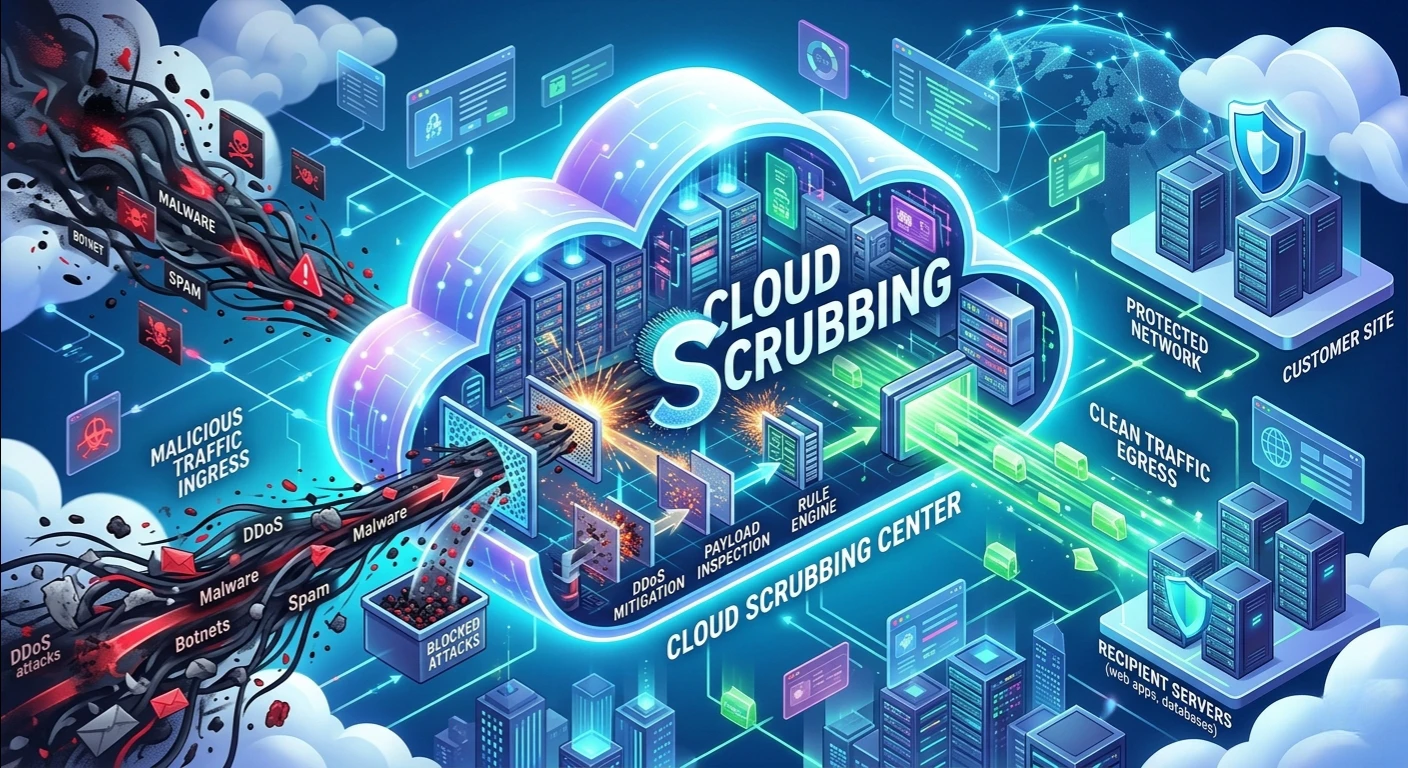
Cloud scrubbing is simply a way to scrub internet traffic. Not everything that comes into your server is secure. Some of it is spam, automated, and/or malicious. The cloud scrubbing catches that traffic, filters each packet, gets rid of the bad ones and passes the good ones on to your network.
In theory it’s simple. The technology that backs it, however, is advanced. It runs in real-time, on a large scale and without impacting your real customers. The speed, accuracy and scale are what has made cloud scrubbing one of the most trusted tools in today’s network security arsenal.
Importance of a Scrubbing Centre
At the onset of an attack, your traffic is diverted to a Cloud Scrubbing Center. A high-capacity facility designed specifically to deal with large quantities of network traffic. The centers have specialized equipment, which can detect attack patterns within a fraction of a second, and intelligent software.
Within the center, a special DDoS Scrubbing Service is provided. Its job is to divide all inbound traffic into separate data packets and look at those packets. The system identifies real users and blocks fake requests, bots, and traffic surges immediately.
The downside is that your server never sees attack traffic. Data is already cleaned when it arrives in your infrastructure. You maintain your website up and running, you keep your users satisfied and you continue to operate your business.
The Technical Side of Traffic Scrubbing
The hands-on process that takes place within the scrubbing center is called Traffic Scrubbing. It is a series of layered inspections and not just one action. Every layer is set to filter out a unique category of threat.
The first thing it does is verify the traffic through certain IP addresses. If one address is trying to send thousands of requests/s, that’s a red flag. Then it looks at the traffic behaviour. Users are using websites in a certain way. Bots and attack tools are very different.
Network Traffic Filtering uses rules to automatically sort network traffic. Teams regularly update these rules to address new attacks, allowing scrubbing centers to quickly identify and block new DDoS threats.
It’s a combination of behavioral analysis and Malicious Traffic Filtering that makes modern cloud scrubbing so effective. Does not depend on one detection method. Uses several layers operating at the same time.
Cloud-Based DDoS Protection Makes Sense
A network can have various protections against DDoS attacks. You are able to install the hardware in your data center, you can depend on your Internet service provider, or you can utilize Cloud-Based DDoS security. Both methods have their usefulness, but cloud computing has some benefits that you can’t find with either of the others.
The top benefit is the capacity. A DDoS attack can produce terabits of traffic per second. There’s no single piece of equipment on site that can handle that capacity. A cloud scrubbing network, however, is spread out in multiple sites and can scale up at will to cope with even the largest attacks ever recorded.
The other benefit is that cost. It costs money for you to own and operate your own DDoS protection equipment. Cloud scrubbing is a service that is already developed, already tested, and already deployed. Most providers will have flexible pricing to cater for businesses of all sizes.
Last but not least, simplicity. You don’t need to be an expert when implementing Cloud-Based DDoS Protection. It’s the provider that will take care of the infrastructure, updates and monitoring. You simply feed them your traffic and they do the rest.
Real-Time Traffic Cleansing During an Attack
The speed of an attack is critical in a DDoS attack. Each minute of downtime costs something – it means loss of sales, loss of reputation, loss of customers. That is why Real-Time Traffic Cleansing is a key aspect of any good cloud scrubbing solution.
If the system detects an attack, it immediately activates automated processes. It diverts traffic, starts scrubbing, and sends clean traffic to your servers within seconds. Advanced systems also use machine learning to improve over time.
They learn from previous attacks, and modify their detection model to detect subsequent attacks even sooner. This type of adaptive approach ensures that Real-Time Traffic Cleansing is more accurate as it goes.
Creating a Full DDoS Mitigation Strategy
DDoS Mitigation is not just a single tool. It is a strategy. Cloud scrubbing plays a key role in the program, and is best complemented by other protective techniques.
A holistic Anti-DDoS Solution will feature ongoing network monitoring, rate limiting, IP reputation filtering, and incident response planning.
Properly configured layers strengthen your company’s security. If one layer fails, others provide backup.
Businesses that prioritize DDoS mitigation stay better protected when attacks occur.
They have effective procedures, quicker recovery times and limited overall damage. The first step to that preparation is picking the right tools — and cloud scrubbing is right at the top of that list.
FAQs
1. How does cloud scrubbing work?
Cloud scrubbing refers to a network security procedure that filters unwanted traffic away from your server. An attack is detected and all incoming traffic is bounced back to a Cloud Scrubbing Center. There, a DDoS Scrubbing Service reads each data packet, filters out any malicious requests, and only passes clean, legitimate traffic on to your network. Everything is done in real-time, meaning that your site will not be taken down or impacted in any way from the user’s perspective.
2. What are the differences between cloud scrubbing and a traditional firewall?
A traditional firewall operates at the edges of your network and is small. It is capable of coping with small attacks but is overwhelmed during a large DDoS attack. On the other hand, cloud scrubbing does not run in your network at all. Cloud-based DDoS protection cleans traffic before it reaches your infrastructure. It blocks attacks on high-capacity global networks, protecting on-site hardware performance.
3. What is real-time traffic cleansing’s speed?
Modern real-time Traffic Cleansing systems respond to an attack within seconds of its outbreak. Automated systems detect abnormal traffic, reroute it to a scrubbing center, and filter malicious traffic without human approval. The process happens quickly, so most users experience no slowdown or downtime.
4. Can cloud scrubbing be used just by large businesses?
Not at all. Many believe DDoS Mitigation solutions only protect large organisations. However, hackers regularly target small and medium-sized businesses because they often have weaker security. These days, most cloud scrubbing providers have flexible charges that fit various budgets. No matter whether it’s a small online retail store or a large financial institution, a suitable Anti-DDoS Solution can be beneficial to any business that operates online.
5. Will traffic scrubbing affect the speed of my website for normal visitors?
No. Traffic Scrubbing causes no noticeable latency for real users. Distributed scrubbing centers clean traffic and route it through the nearest center. Network Traffic Filtering blocks only suspicious or malicious requests. Traffic from a legitimate user goes through quickly and arrives at your server exactly like it would without this filter. When an ordinary user logs in, their traffic goes through and arrives at your server as it would if you didn’t have this filter.
Final Thoughts
All online businesses are at risk to various extents. The DDoS attack is here to stay. They are becoming even more common and more intense each year, if not more. It’s a very expensive mistake to wait until you’re hit to think about protection.
Cloud scrubbing provides proactive protection. It protects your network, your servers, and your users — even when the attackers are out of control. Businesses of all sizes can benefit from a DDoS Scrubbing Service with proven Malicious Traffic Filtering and Network Traffic Filtering by preventing attacks.