
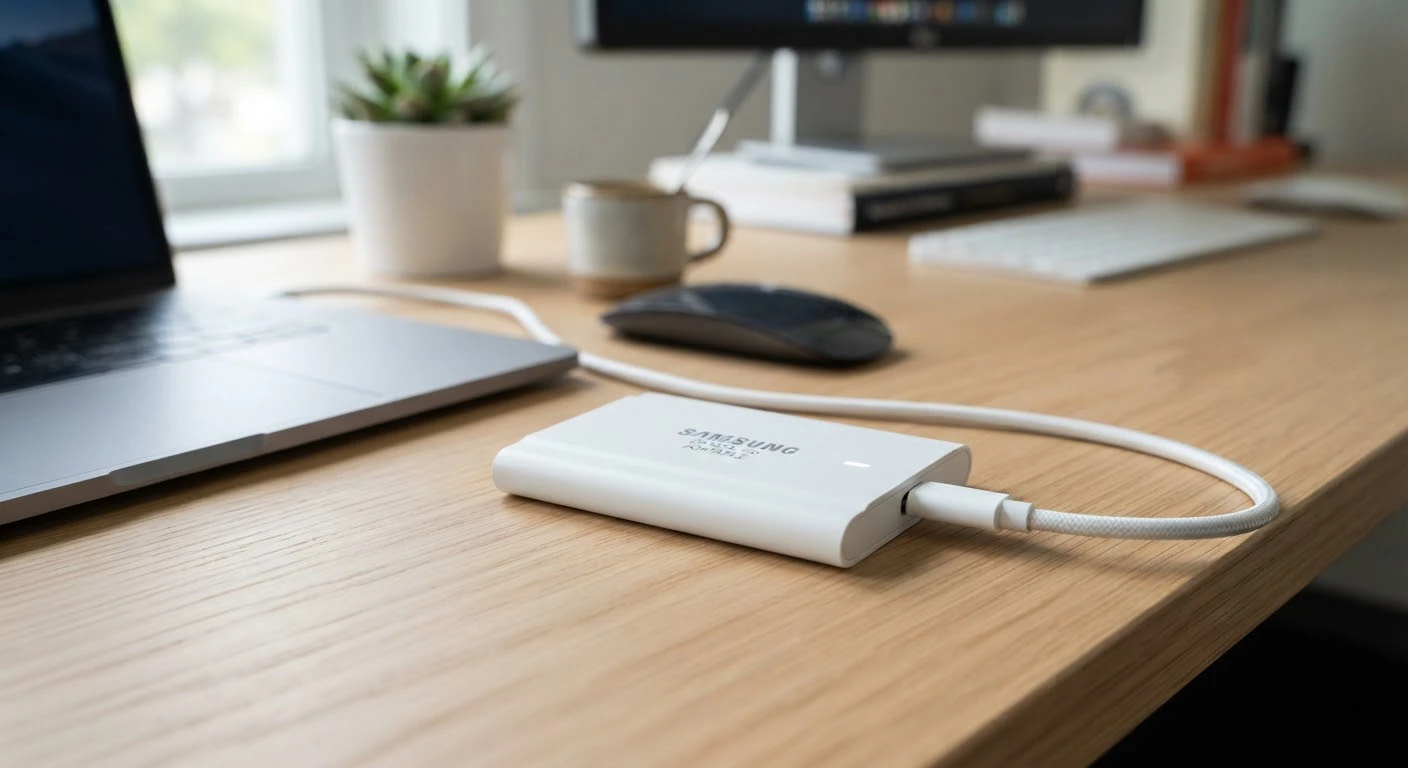
A white SSD drive is any solid state drive that has a white casing, label or enclosure. It has the same internal operation as other SSDs. It is based on the flash memory and does not require spinning platters, as a result of which it loads files faster, boots your system faster and produces no sound.
The white finish is primarily aesthetic, and it’s a matter of taste for those interested in aesthetics. For a clean and simple setup, many people opt for a white solid state disk, or perhaps someone just selects one because it looks good with their gear.
Types of White SSD Storage
There are several main formats for SSDs, and not all SSDs will fit every device so it is beneficial to know the main formats.
White SATA SSD
The standard 2.5″ Drive. It is compatible with most desktops and older laptops and will be safe to upgrade when replacing a hard drive.
The NVMe drives are fast and are connected directly through PCIe, as opposed to SATA. A white NVMe SSD is ideal for gamers, editors and those who frequently move large files.
The M.2 form factor is the small stick-shaped form factor, and the “White” designation refers to the white side that connects to the motherboard. Some M.2 drives are NVMe, others are SATA, so be sure to check your motherboard or laptop to ensure compatibility before making a purchase. Most M.2 drives are flat and a white label (or heatsink) is the one you’ll see.
White Portable SSD
A white portable SSD is a small external storage device that you can take with you in your pocket or bag. It’s convenient for backups, traveling projects, and moving projects between computers.
White External SSD
This is the more general class of drives that are connected via USB. A white SSD enclosure or white SSD case can help convert an internal drive into a portable drive, if necessary.
Distinction Between the Two Types of SSDs
A white solid state drive (SSD) is inside your computer. It’s the superior option for your operating system, games and everyday programs since it’s constantly connected and typically quicker.
If flexibility is required, then the white external SSD is better. It can be connected to a laptop, desktop computer and even some consoles. It’s suitable for backup and large file sharing.
White SSD for Gaming PC, Laptop and Desktop
Gaming builds are a matter of style and speed, and White SSD for gaming PC is no exception. A white gaming SSD with the NVMe interface will help to reduce loading times and look great in a white gaming PC. However, in case your motherboard has a heatsink cover over the M.2 slot, keep in mind that in case it’s a hidden drive, it’s not as important as speed.
Generally, laptops have limited space, so please determine if your laptop has a 2.5-inch SATA bay or an M.2 slot. It may be rare to see much difference between the laptop and the external drive in terms of appearance, but a white external drive will certainly look nice beside the laptop.
With desktops, you have the most freedom, which is why they are a good solution for desktop users. You can combine a small NVME boot drive with a bigger SATA drive for additional files, and, if your case has a glass-sided panel, you can display a white SSD.
How Much Storage Do You Need?
Choosing the right size is not only a cost-saving option, but also prevents premature upgrades.
- 500GB: It’s enough for operating system, work apps and some games. A white 500GB SSD is a good boot drive.
- 1TB: Most people will be okay with this. A white 1TB SSD won’t feel out-of-breathe while playing games, working on projects and storing day-to-day data.
- 2TB: For large libraries, video editors and heavy gamers. A white 2TB SSD will give you plenty of space to expand.
Games and video files continue to grow and if you have the funds, it’s better to go 1 size up.
White SSD vs HDD
There’s a lot of discussion about the white SSD vs. HDD. The SSD is much faster, powered less, shockproof and quiet. For bulk backups, a traditional hard drive will provide you with more storage per dollar. Most people have both drives – an SSD for the OS and active files, and an HDD for archives. If you’re looking for a computer storage drive that is white and also improves performance, there is no question of an SSD.
Before Purchasing, Make Sure to Verify These Items
- Check if your device can support SATA, NVMe or M.2 prior to purchase.
- It’s not only the storage space that varies from drive to drive; the speed at which data can be read and written is also different. The faster the SSD, the better for games, editing and heavy multitasking.
- Capacity: Size to match the way you use your computer.
- Design and extras: RGB lighting or white aesthetic SSD finishes are sometimes available with some drives. White SSD accessories, such as heatsinks, brackets and enclosures, can complete the look.
- Look at the warranty period and reliability, particularly if you have a lot to write.
- Price: The price of the white SSD will vary depending on its capacity, speed and brand, so shop around. For some models, a white copy may be slightly more expensive than the original black copy; for others, the price may be the same.
Tips to Keep in Mind for Seamless PC Storage Upgradation
Upgrading your PC’s storage, especially when you’re going for a white-themed drive, is about more than just looks. A smooth upgrade comes from making the right choices in the right order.
1. Compatibility Comes First
Before anything else, check that the drive actually works with your system. Look at the interface (SATA, M.2 NVMe, or PCIe), the form factor (2.5-inch, 3.5-inch, or M.2 2280), and whether your motherboard has a free slot or connector for it. A drive that doesn’t fit your system is useless, however good it looks.
2. Then Consider Speed and Size
Once compatibility is confirmed, choose a drive whose speed suits your workload. NVMe SSDs are ideal for fast boot times, gaming, and editing, while SATA SSDs or HDDs work well for backups and bulk storage. Pick a capacity that covers your needs today with some room to grow.
3. Color Comes Last
A white drive is a great way to match a white PC build, but looks should only be the final tiebreaker. If a white drive is slower, runs hotter, or reduces your system’s performance, skip it. Never trade performance for aesthetics.
FAQs
- What is a white solid-state drive (SSD)?
It is a solid state drive (SSD) that has a white casing or finish. It works just like any other SSD but looks like an SSD with a light theme.
- Does it matter if an SSD is white or black?
No. Color doesn’t influence the speed. Performance is not dependent on the finish, but the interface, controller and memory.
- White NVMe SSD or White SATA SSD?
NVMe is significantly faster and better for work and gaming. SATA is more affordable and it can be used with wider systems.
- Is it possible to install a white M.2 SSD on my laptop?
Yes, if your laptop has a compatible M.2 slot. See if it does support NVMe, SATA or both.
- How much white SSD to purchase?
Most people will want to go with 1TB. Select between 500GB (light use) and 2TB (large game libraries and media).
- Is it possible to convert the internal SSD to portable SSD?
Yes. A white SSD enclosure or case enables the internal drive to be connected using the USB port.
- What is the difference between SSD and HDD?
Yes, for speed, noise and durability. When you need to store backups in large volumes at a low cost, HDDs still come in handy.
Conclusion
If you desire faster computer performance and a nice, modern look, then a white SSD drive is a good solution. Pick a SATA, NVMe, M.2 or portable SSD, and ensure that it is compatible with your device and has sufficient storage for your needs. The right white SSD can help improve the performance of your PC or laptop, as well as give your machine a nice appearance.