
One of those decisions that you procrastinate until you’re in a rush typically at the moment that your site begins crashing under load it was never designed for. From a personal blog, to an online store, to a company website, the hosting that powers it makes the dark magic shaping your website’s performance, uptime, and security.
Many people still consider hosting to be merely “storage space purchasing. It isn’t, not anymore. A good host these days should have good server equipment, actual security, reliable backups and support that comes when things go wrong at 2am. This is a guide to what super hosting entails, what it looks like, the various types of super hosting and how to decide on one without being sold on what you don’t need.
What Exactly is Super Hosting?
Super hosting is simply a better level of hosting a type based upon SSD drives, cloud resources, optimized servers, and up-to-date security protocols, rather than the minimum hosting an inexpensive shared plan offers.
The benefit of the appeal is flexibility. You don’t have to go nuts now, and make your site slow when you have a lot of visitors, you can start small and scale up as your traffic increases.
Why Does It Actually Matters?
What people don’t consider: the hosting has an impact on more than just the ‘up’ of the site. Slow pages lose visitors and that is a problem. Repeatedly interrupted websites have faith — and search engines. Google will know when your server is running slow, and your visitors will also notice it, typically within 3 seconds.
Great hosting comes in a few definite forms:
- Pages appear to load faster = it is easier to find them.
- It remains up more reliably.
- It can be kept up easier.
- Fewer security scares.
- Over time, the website will be more discoverable.
- The visitors remain on site.
All of this is not speculation, it’s the distinction between infrastructure that can handle real traffic and infrastructure that just barely gets by.
Hosting Isn’t a Monolithic Entity
Not all websites have to be configured in the same way. Here are approximate comparisons of the options.
Shared Hosting
If you have a blog or a small business site that’s not generating a lot of traffic, you should start with shared hosting. The downside: You’re sharing server resources with a group of other sites; during busy times, performance may suffer.
VPS Hosting
With VPS hosting, you will be using your own portion of a server, even though you are actually still sharing the server’s physical machine. It’s a decent middle-ground between shared hosting and a full dedicated server, so it’s not as fast or secure, but it’s also not as expensive. It’s a common spot for businesses with growth prospects.
Cloud Hosting
With cloud hosting, your website is deployed on several servers rather than one box. In the event that there is a problem with one server, another will take over without any problem, meaning downtime is unlikely.
Dedicated Server Hosting
With Dedicated server hosting you are given a dedicated server, with no sharing whatsoever. While it might be unnecessary for a small blog, it’s a must-have for high traffic enterprise blogs.
WordPress Hosting
Optimized WordPress hosting, auto-updates, caching, security optimizations, and other things a generic server wouldn’t have pre-prepared for WordPress.
A Good Host Should Really Bring and Serve
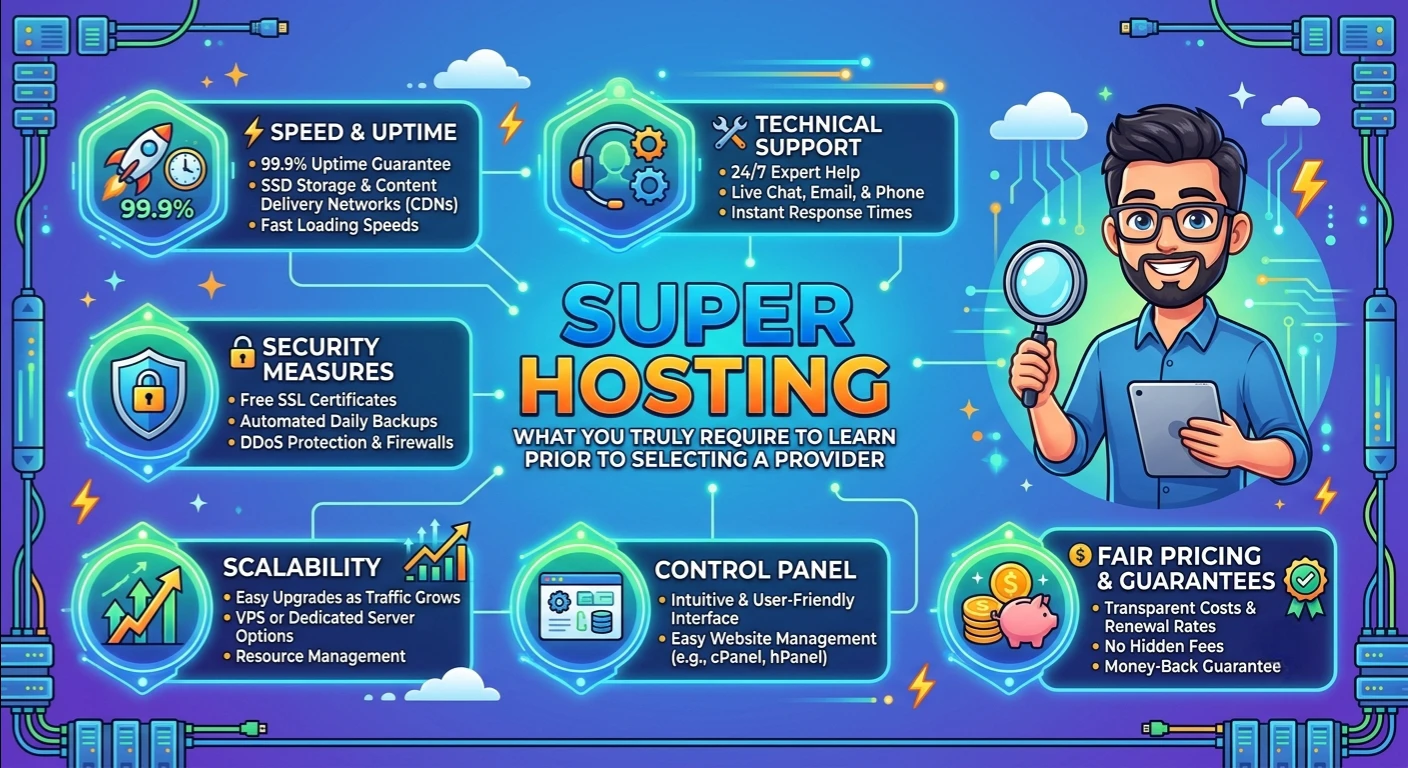
Basically, spinning hard drives are now a legacy of the past with the coming of fast storage. SSDs provided faster reads, faster database queries, and less waiting around.
Free SSL
It should not be a feature that you have to pay more for, but a lot of budget hosts will still charge you for it. If your site doesn’t have SSL, browsers treat them as suspicious and that isn’t a good first impression.
Real Uptime
Less than 99.9% should make you raise an eyebrow. Request providers to provide actual uptime numbers and not just a number from their home page.
Security
Security that extends beyond the firewall: Malware scanning, DDoS protection, automatic backups, and someone who’s monitoring for threats — not just a list of security features.
Performance
Most sites don’t need much in terms of raw storage, they need performance tuning, caching, CDN support, decent hardware etc.
How Exactly to Decide on a Provider?
Infrastructure
Modern data centres, redundant power, solid networking. Some trivial data, but necessary when something upstream fails.
Support
Test it first, ask something via live chat at a random time, and see if you can get a genuine response, not a scripted one.
Scalability
Don’t want to move everything to a new platform because you doubled your traffic.You don’t want to move everything to a new platform because you doubled your traffic. The good provider allows you to scale as needed.
Price vs. Value
The lowest cost plan is not the most valuable when considering all of the features it provides or doesn’t provide backups, SSL, support, etc. Look past the sticker price and at what it includes.
Control Panels
cPanel
For a reason, cPanel remains the industry standard: It makes domain, email, database, and backup management a lot easier than doing it the hard way.
Linux Hosting
The majority of the Web is powered by Linux hosting and works perfectly with PHP, MySQL, WordPress, Laravel and most popular frameworks.
Windows Hosting
There are very few sites built on ASP that use Windows hosting.A smaller market, but critical for businesses that require it, are those using NET, MSSQL or other Microsoft-specific tools.
A Few Extras to be Aware Of
Email Hosting
Email hosting allows you to send emails from a different address than, say, support-gmail.com, but it’s not as important as you might think.
Domain and Hosting
For those who may not want to manage two different accounts and renewal dates, bundled domain and hosting is convenient.
Reseller Hosting
Many small agencies start hosting by using reseller hosting.
Migration Support
Migration support – A good provider will take all your files, databases and email and move it over, often with no downtime and for free.
For Small Businesses
But what’s important here is less flashy—fast loading pages, guaranteed uptime, actual security, backup of data every day, business email, support when things go wrong. No frills — infrastructure that does not impede the business.
For Larger Operations
Enterprise level hosting is another story altogether – dedicated infrastructure, load balancing, serious monitoring, disaster recovery plans. If downtime equals real dollars, the hosting budget is no longer up for discussion.
On “Unlimited” Plans
A word of caution: Many providers that offer “unlimited” hosting and bandwidth include a fair use policy in the fine print. It is not always a scam, but be sure to read the terms first, and don’t assume that there’s no ceiling.
Bottom Line
There is no one “best” type of hosting; it will depend on the needs of your site, and not necessarily what sounds more impressive. Having a dedicated server for a small blog isn’t necessary and having a growing e-commerce store on shared hosting isn’t necessary either, once it reaches a certain size. Don’t sign up anywhere without checking out real plans, checking the support team, looking at the security, and verifying the basics, including SSD storage, free SSL and migration path if you’re switching from somewhere else. If you do, then hosting doesn’t become a topic of your mind ever, which is what you need.