
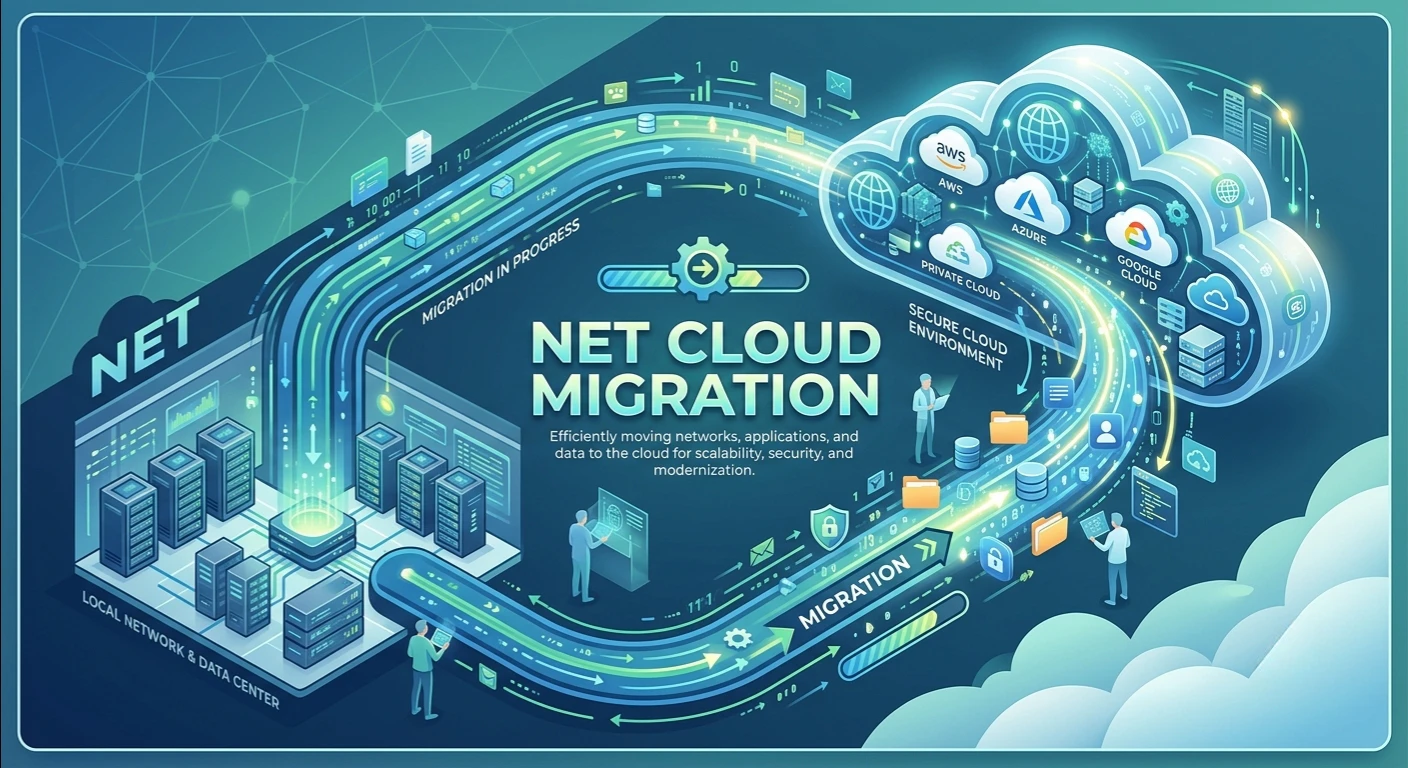
Looking to plan a move to the cloud? This is an easy-to-follow resource that provides strategy, process, tips, and tricks to help your business get to the cloud without the fuss.
In today’s business environment, all businesses are facing the same challenge: modernize quickly, scale without overspending, and reduce overhead. Therefore, it comes as no surprise that the subject of net cloud migration is still a topic of conversation for IT leaders, CTOs and founders alike. If you own a five-person startup or manage infrastructure for a global enterprise, you can save yourself a lot of time, money and stress along the way if you get a solid handle on what net cloud migration actually entails.
This guide takes you through what net cloud migration actually entails, why it’s so hot on the market now, how it usually works and what you need to do to make it work for you.
What is Net Cloud Migration?
Net cloud migration is the complete move of an organization’s digital resources—its applications, data, workloads and IT resources—from on-premises servers or outdated legacy systems to the cloud. Remember the word “net”: it’s not just about the mechanics of the move, it’s all about the costs, downtime, performance, benefits and value of the overall move once it’s over.
This is what differentiates net cloud migration from a mere system upgrade. It’s a comprehensive transformation. Migration is not just a single technical action, it considers the return on investment, provides a realistic understanding of ROI to decision makers before they invest budget and resources.
Why Are Businesses Moving to the Cloud?
There’s a good reason why so many businesses are moving to the cloud.
1. Cost Efficiency
Physical servers are not inexpensive to operate and maintain. Net cloud migration eliminates that headache, with less frequent hardware refreshes, reduced maintenance costs and a more steady, ongoing cost of operations.
2. Scalability
Cloud environments allow you to scale resources up or down nearly instantly as per real demand. It’s a massive advantage for businesses that experience sudden surges of traffic, or are expanding quicker than their current infrastructure.
3. Stronger Security
The best cloud migration services also include various layers of security, routine patching and compliance certification — which is a lot of effort and expense to implement on your own.
4. Business Continuity
Major cloud providers have good disaster recovery offerings as your data and applications remain accessible with unexpected events.
5. Better Collaboration
With cloud adoption, teams can pull up data and applications from anywhere. This is really significant these days, when remote and hybrid work are the norm, not the exception.
Choosing the Right Cloud Migration Strategy
Deciding which approach is suitable for the business is the first step in migrating anything. Here are the primary alternatives:
- Public Cloud Migration: Relocating workloads to shared, third-party-managed clouds, such as AWS, Azure, or Google Cloud.
- Private Cloud Migration: Migrating to a dedicated, single tenant environment for greater control and customization.
- Hybrid Cloud Migration: Combining on-prem infrastructure with public or private cloud resources for enhanced flexibility.
- Multi-Cloud Migration: Deploying applications on multiple cloud platforms to prevent vendor lock-in and maximize performance.
It will depend on your regulatory requirements, budget, existing infrastructure and where your business will be in a few years.
Cloud Migration is Indeed The Process that Occurs
Step 1: Assessment and Planning
To move applications to the cloud, you must have a clear-eyed audit of what you’re moving. It means identifying which applications, databases and workloads are truly cloud-ready, and which must be re-designed before they can even begin to move in the cloud.
Step 2: Select a Migration Strategy
From that evaluation, most companies select one of the following tried-and-true strategies: rehost (lift and shift), replatform, refactoring, repurchasing, or simply bipping out systems that no longer justify their expense. The options you make here will influence the direction of your cloud migration planning.
Step 3: Migrate Data and Applications
The real transfer takes place here: files, databases, applications transfer. Cloud data migration, especially database migration, must be handled with great care, as a hasty migration can lead to data loss, corruption, and longer downtime. Old systems and new systems are typically kept in parallel for some time until the cutover is complete.
Step 4: Migrate and Test Workloads
When there is data, the workload migration begins – moving processing workloads, applications and services to the new environment. This process entails a lot of testing to ensure that all components work properly, remain stable and integrate smoothly before it is live.
Step 5: Application Modernization
Many companies see this as an opportunity to transition more than simply old software. Application modernization is the process of taking old applications and rebuilding them with cloud-native architectures, such as microservices, containers, etc., so that you are truly leveraging the capabilities of the cloud, and not just placing your old application in a new location.
Step 6: Optimization and Continuous Monitoring
Migration is not really over after the final workload is dropped off. There’s a need for continued monitoring post-implementation; measuring performance, monitoring costs, and tuning resources to ensure the cloud environment continues to provide value rather than subtly becoming another line on the cost report.
Final Thoughts
Migrating to the cloud isn’t solely a technology update, it’s a real paradigm shift in working for a business. When you do, it pays off: lower costs, improved scalability, and enhanced security. Cloud technology continues to change, and it is the companies that invest in getting it right now that will have the headroom to accelerate further in the future.
When your organization is considering cloud migration, the time to get started is now, so it’s time to plan out your net cloud migration journey with a clear plan and the right people on board.