
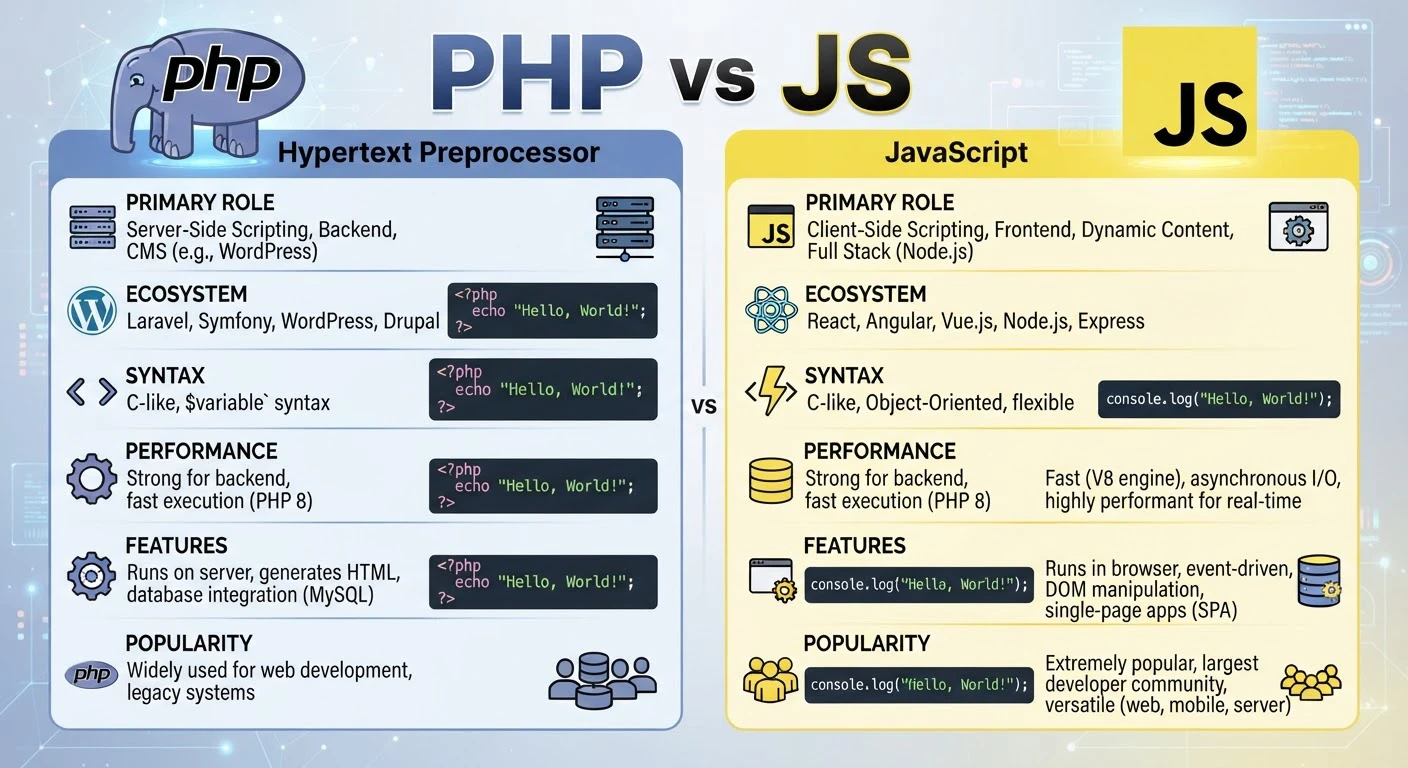
You’ll find 10 different strong opinions if you ask 10 developers whether they prefer php or js. Both languages have powered a huge portion of the web for decades, yet creators built them for different tasks, and they remain distinct today. When choosing a language to learn or use for your next project, a clear comparison helps more than hype.
It covers the workings of each language, the areas where each language excels and the decision process without second-guessing.
What Is PhP?
PhP is a server side scripting language to create dynamic websites. The server executes the code, builds an HTML page, and returns it to the browser. It handles form processing, user logins, database queries, and content management.
PHP stays popular largely because WordPress—which powers a huge share of websites—relies on it.
On top of that, modern PHP is much better than it was reputed to be! Version 8 introduced a faster engine, cleaner syntax and more robust typing.
What Is JavaScript?
Creators initially conceived JavaScript as a client-side scripting language to make web pages interactive. It runs in the browser and controls menus, animations, form validation and live updates without reloading the page.
Then there was Node.js, and JavaScript could run on the server, too. Now, from the buttons on a page to the database itself, JavaScript can do it all.
The Core Difference
Execution location offers the easiest way to tell PHP and JavaScript apart.
PHP is located on the server. Browsers only see your PHP output, never the source code. Meanwhile, JavaScript runs primarily in the browser, though Node.js can also run it on a server.
That is why it is not uncommon for many projects to employ both. PHP handles the backend data and pages, while JavaScript keeps the interface fast and responsive.
PHP vs JavaScript for Backend Development
The PHP language is designed for backend programming. It’s inexpensive and nearly ubiquitous, easy to implement and well established. When working with PHP backend and using a framework such as Laravel or Symfony, small teams can deliver high-quality products in a relatively short time.
With JavaScript back-end app development using Node.js, it’s another matter. It operates on an event-driven, non-blocking basis, making it efficient for handling numerous concurrent connections – ideal for chat applications, streaming, and real-time systems. When comparing PHP vs Node.js, Node will be more natural for real-time sites, and PHP is more natural for page-based sites and content platforms.
Comparing PHP and JavaScript for Frontend
This isn’t really a competition.Browsers run JavaScript, while PHP cannot handle interactive browser tasks. Developers build frameworks like React, Vue, and Angular with JavaScript, making it the standard language for frontend development.
Although PHP can still generate the initial HTML for JavaScript to enhance, it does not replace JavaScript on the client side.
Performance and Speed
There are many debates about PHP vs. JavaScript performance, but the truth is that it depends on the task.
Node.js is implemented on top of the V8 engine, a very fast and efficient engine that Google owns. PHP 8 has been improved in terms of speed and is quite efficient for standard web requests. The difference in speed is not as significant as the difference a good database design, caching and clean code make for most websites and business apps.
Never select a language on the basis of a benchmark. Your architecture and hosting tend to be more important.
Syntax and Readability
There are some similarities between PHP and JavaScript syntax—both languages have a lot of the same concepts, so curly braces and semicolons will be familiar to you. Variables begin with the dollar sign ($) in PHP and PHP blends in with HTML. There are things to get used to: JavaScript features let and const, and its async/await syntax and promises can be a bit tricky at first.
Well written, they are not difficult to read. Messy code is possible in both.
Frameworks and Ecosystem
The PHP vs JavaScript frameworks image is similar to this:
- PHP: Laravel, Symfony, CodeIgniter and CakePHP (back end) WordPress, Drupal (content management).
- JavaScript: React, Vue and Angular on the frontend, and Express, NestJS and Next.js on the server side.
npm has expanded the JavaScript ecosystem and speeded it up. This gives us more options but it’s also more decision making and more changes to follow up. The PHP ecosystem is more compact, but more stable, and simpler to navigate.
Security
Both languages are neutral with regards to safety and unsafety. When it comes to the PHP vs JavaScript security debate, the true danger is in the coding. Both have problems due to unvalidated input, weak authentication, and outdated packages.
Modern PHP frameworks handle many security protections automatically, whereas legacy PHP code often lacked them—giving PHP a bad reputation. In JavaScript, watch your many third-party dependencies carefully. In both cases, keep everything updated and validate all inputs.
Scalability
Both can scale. Popular languages for microservices and real-time applications are JavaScript and Node.js. Yes, PHP can be scaled, with caching, load balancing and good database usage, and large platforms have proven this for years.
In terms of PHP vs JavaScript scalability, keep in mind that scaling is a primarily architectural issue and not a language issue.
Higher Level Achievement RATING Learning Curve and Popularity
When it comes to learning PHP versus JavaScript, PHP may be easier to get into in the beginning for backend projects since you can write a script and publish it and immediately see the results. Front-end developers cannot avoid JavaScript, so most end up learning it.
JavaScript leads PHP in global popularity because developers use it for both front-end and back-end work. Still, PHP remains popular for WordPress and many major business websites.
The Use Cases of PhP vs JS
Select PhP if you desire
- A website, blog or online shop that is focused on content.
- A WordPress or other similar CMS project
- Fast and cheap hosting and speedy site setup.
- A stable,
- A solid stable and mature backend.
Select JavaScript to use
- A very interactive interface
- Live interactive tools, such as chat or dashboards
- This is a single language on both front and back end.
- A single page application or a modern web application.
How to Decide?
Begin with your project and not the language. When you’re creating a site that primarily provides content, PHP is a solid and functional option. When developing an interactive app, JavaScript is almost a no-brainer. For the learner who desires maximum career opportunity flexibility, it would definitely be a good idea to start learning JavaScript and then learn PHP.
There are plenty of teams in the real world who use both and that’s just fine!
FAQs
What’s the difference between php and js?
JavaScript is primarily executed in the browser, primarily used for making pages interactive, PHP is primarily executed on the server, primarily used to create pages. JavaScript also has the ability to run on the server with Node.js.
Do you still need to learn PHP?
Yes. It is used by WordPress and many popular websites and will keep PHP skills in demand.
Which one of PHP or JavaScript is faster?
That depends on the number of tasks you’re doing. With PHP 8, you can expect to see high performance for typical website requests; Node.js will manage plenty of simultaneous connections. It is important to have good architecture, not the language.
Is it possible to mix PhP and JS?
Yes and it is very common. The PHP code is used for the back end logic and data, while JavaScript is used for the interactive interface.
Is PhP to Node.js a level playing field?
Partly. The closest match to PhP on the server side is the JavaScript runtime Node.js. Both can be used for various project types.
Which is safer?
Both are not more secure in and of themselves. Input validation, updates and coding practices are key to security.
For a beginner, which do you think is the first skill to acquire?
If you’re looking for frontend or full stack skills, then you should begin with JavaScript. Once you need to be able to construct sites quickly with a CMS, PHP is a slow beginning.
Conclusion
There’s no answer to the php vs js question. As for the languages themselves, PhP is reliable and effective on server side, content oriented sites, and JavaScript is necessary for interactivity, and can be used throughout the stack. Choose the one that will work for your project, your team and for your goals, and don’t be afraid to mix and match.
Ready to launch your PHP or JavaScript project on fast, reliable hosting?