
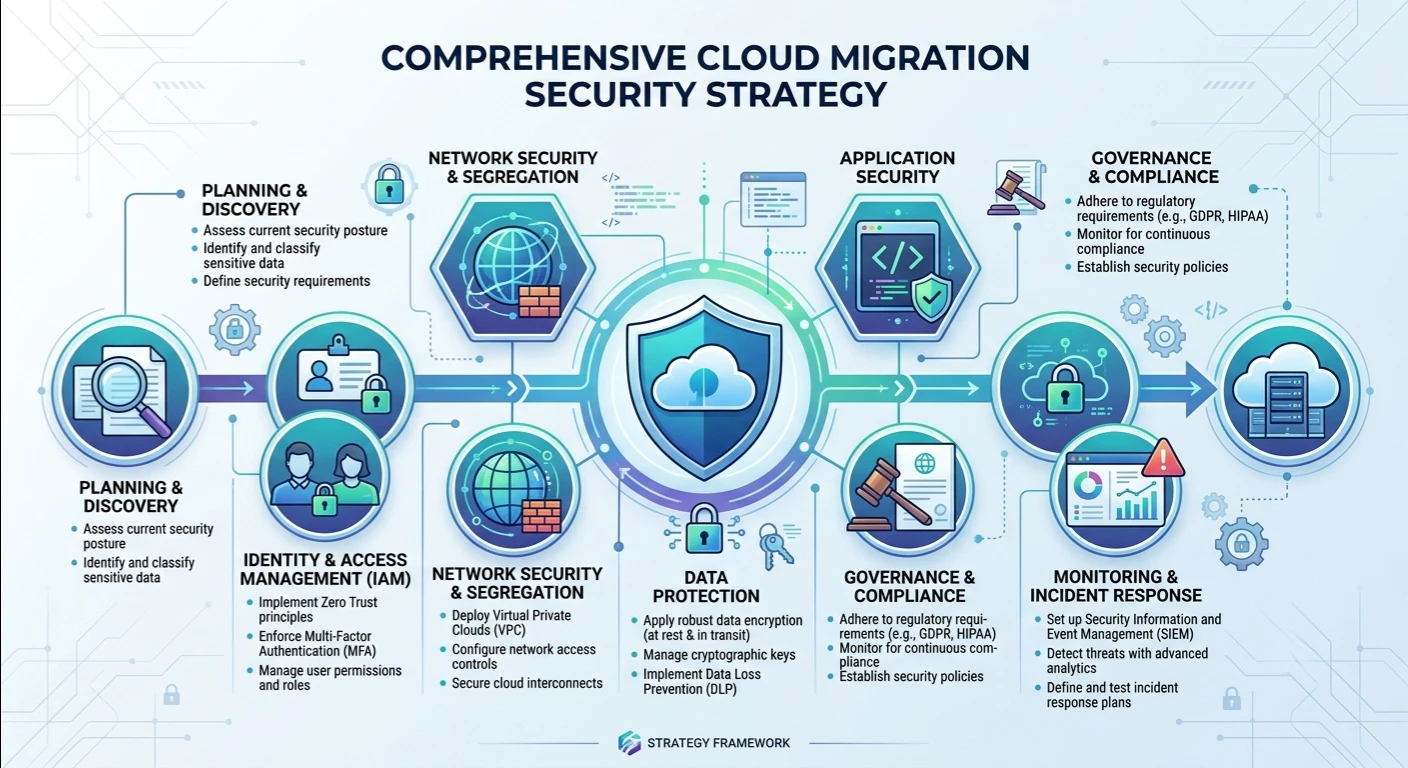
Cloud computing has been integrated into the modern-day IT infrastructure. Both small and large organizations are abandoning their legacy data centers and adopting cloud platforms to enhance speed, cost reduction, and scalability. However, without a strong cloud migration security strategy, businesses risk data breaches, compliance issues, and costly cloud migration failures. Attention should be paid to a safe and thorough plan to secure the workloads, applications, and sensitive data at all levels of migration.
What Is Migration in Cloud Computing?
Before diving into security, it is important to understand what is migration in cloud computing. Cloud migration is defined as the migration of digital assets such as applications, servers, databases and workloads in an on-premise environment to a cloud platform. This may comprise public cloud migration, private cloud migration, cloud to cloud migration or even multi cloud migration strategies depending on business goals.
Why Move Applications to the Cloud?
There are many reasons why applications move to the cloud. There is increased flexibility, high availability, enhanced performance, and access to advanced tools in businesses. Cost efficiency, automatic updates, disaster recovery and simple scalability are also benefits of cloud migration. Yet, all these benefits can be fully achieved only in the case when security is taken into consideration in the migration plan itself.
Key Considerations for Cloud Migration Security
A successful cloud migration security strategy begins with understanding risks and planning controls. Some key considerations for cloud migration include data classification, identity and access management, compliance requirements, and threat detection. Security should be taken care of prior to the migration to the cloud and not after the migration process has taken place.
Cloud Migration Analysis and Assessment
A comprehensive cloud migration analysis helps organizations identify workloads they can migrate and uncover potential security gaps. This step often involves a cloud migration assessment that reviews applications, infrastructure, and dependencies.
Many organizations use a cloud migration assessment checklist or an on-premises-to-cloud migration checklist to ensure they cover every important step.
Other issues that businesses need to consider during assessment are the cloud migration issues that they are likely to encounter, i.e. legacy system compatibility, data sensitivity and regulatory issues. . Skipping this step is one of the leading causes of cloud migration failures.
Secure Cloud Migration Planning
Planning a secure cloud migration requires selecting the right architecture and tools. Security controls and controls must be in line with cloud-native best practices regardless of the adoption of azure cloud migration strategy, Google cloud migration services, and other services.
Companies are supposed to establish encryption requirements, segmentation policies in the network, and backup policies. Having cloud migration tools, which are compatible with automation and enforcement of policies, minimizes human error and enhances uniformity among the environments.
Moving Data Center to the Cloud and Server Security
In the course of cloud data center migration, sensitive information tends to move across environments. It is a very critical phase where attackers can take advantage of vulnerabilities. It is necessary to use encrypted connections, secure APIs and track transfer channels. Organizations usually engage service providers of server migration to guarantee integrity of data and less downtime.
Net cloud migration strategies are used by those businesses that have to handle large volumes of work and at the same time achieve good optimization of the network and at the same time, good security measures.
Cloud Migration and Management Services
There are numerous organizations that opt to engage a cloud migration and management service provider. These vendors provide cloud migration advisory services, implementation services, and post-migration monitoring services. They are skilled and lessen the risks as well as practising best practices.
Cloud migration and management services also include continuous security monitoring, patch management, and compliance reporting, which are essential for long-term protection.
Secure Migration Tools and Technologies
The next important step is to select the most appropriate cloud migration tool. Cloud migration tools are reliable migration tools that offer automation, dependency mapping, data transfer security, and discovery. The tools are also useful in avoiding configuration errors that may cause breaches.
The security-oriented tools supplement identity validation, encryption and logging, which are critical in an effective cloud migration security framework.
Cloud Migration for Small Business
Cloud migration requires a slightly different approach for small businesses. Smaller companies often have limited resources and security expertise, but they still face the same threats as large enterprises. A simplified yet effective cloud migration security strategy allows small businesses to protect data while benefiting from cloud scalability.
Managed services and pre-configured security frameworks can assist small businesses to perform the right things and minimize overheads in operations.
Cloud Migration and Modernization
Innovation should not be detached from security. Cloud migration and modernization focus on improving application architecture while enhancing protection. The current cloud-native services provide in-built security solutions that include identity management, real-time monitoring, and automated compliance solutions.
Modernization is also the answer to technical debt, and therefore, applications are easier to secure and maintain.
Multi Cloud and Hybrid Security Problems
A multi cloud migration strategy allows businesses to avoid vendor lock-in, but it also increases complexity. Every platform possesses their own security tools and models. A unified cloud migration security strategy ensures consistent policies across providers.
The hybrid environments that will involve the use of on-premise systems with cloud systems should be handled with care to avoid data leakage and loopholes in access control.
Avoiding Cloud Migration Failures
Many cloud migration failures occur due to poor planning, weak security controls, or lack of expertise. Bringing cloud migration experts on board will also enable the early detection of risks and the introduction of mitigation measures.
Focused on performing regular audits, penetration testing, and monitoring allow identifying the vulnerabilities before they become a significant incident.
Cloud Migration Case Study Value
A well-documented cloud migration case study demonstrates how proper planning and security controls lead to success. Case studies point out what has been learned, what pitfalls have been found, and what are the best practices that other organizations can learn to apply in their migrations.
Advantages of Moving to the Cloud Securely
The advantages of moving to the cloud go beyond cost savings. Protective cloud platforms can promote innovation, telecommuting, and scaling. With a strong cloud migration security strategy, businesses can confidently protect customer data, meet compliance requirements, and maintain trust.
Final Thoughts
A well designed cloud migration security strategy is the cornerstone of a successful cloud migration journey. From cloud migration assessment and planning to the execution and management phase and further, security should remain a top priority. With the help of detailed checklists, trustworthy tools and professional advice, companies may avoid the prevailing problems of cloud migration and may exploit the potential of cloud computing.
Regardless of whether you are taking a public cloud migration, a private cloud migration, or a complex path to the hybrid world, safe migration guarantees stability, performance and growth in the more digital world over the long term.