

SSL is essential to the credibility, reputation, and reliability of either a personal blog or a business website. Activating Web 2.0 A feature of the website owners who have hired IONOS includes several problems that commonly occur as a result of enabling SSL, including the presence of warnings in the browsers, mixed content error, and slow redirection on the side of the browsers. Understanding how to fix an SSL certificate between ionos and wordpress can save you time, traffic, and credibility.
In this paper, we clearly explain how to fix SSL issues between IONOS and WordPress. The document describes all the steps in a straightforward manner, so even laymen can follow them.
Why Specially, the SSL Issues Occur Between IONOS and WordPress
A secure socket certificate will encode data shared between the WordPress site and client browsers. IONOS supplies SSL certificates. However, this may fail if WordPress settings, server setup, and content URLs do not fully match HTTPS.
Common causes include:
- WordPress address URL still set to HTTP
- Old links of images or scripts in the content.
- HTTPS not forced properly
- Browser videos and files have expired versions.
- The server rules missed or contained errors in the rewrite.
A solution to these issues will make the lucrative crust of your web site functional on all the pages.
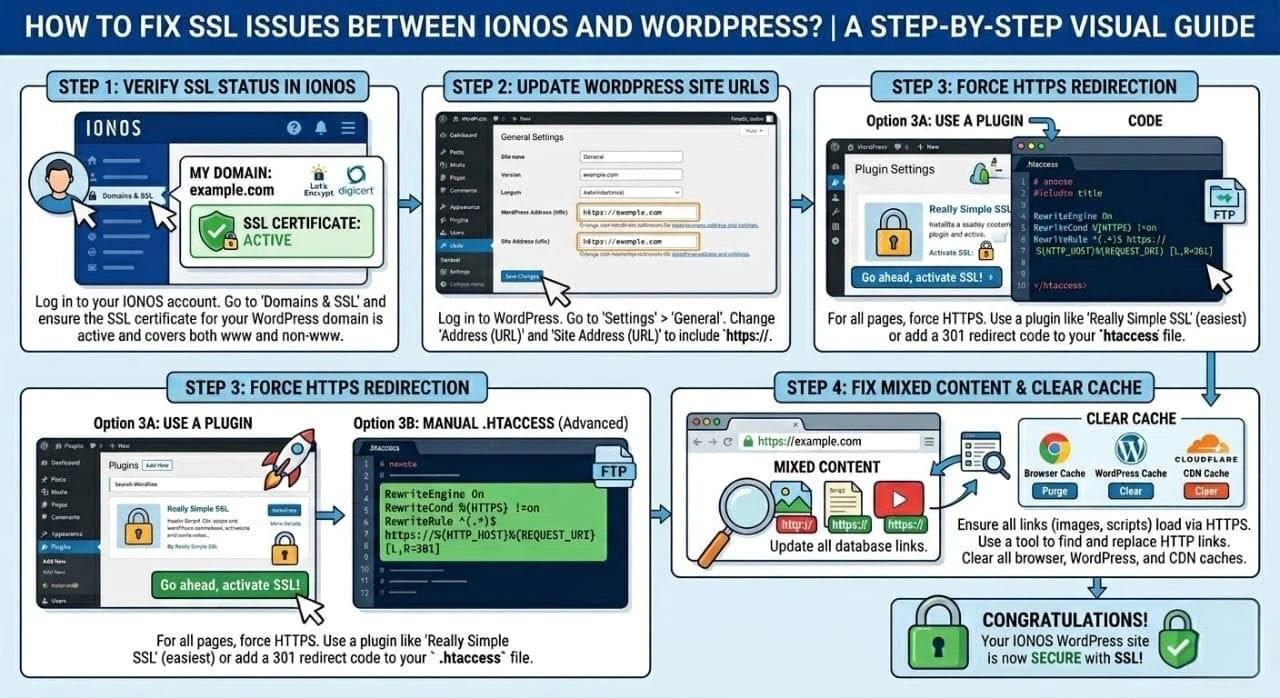
Step 1: Check to Make sSure that The IONOS Has An Active SSL Certificate
Always switch on your SSL certificate in the IONOS dashboard before you make any changes in WordPress.
Enter into your ionos account and ii) adjust the settings of the domain. Make sure:
- A certificate of the TLS protocol is employed on your domain.
- Status on certificate is active.
- HTTPS helps solve the domain.
You cannot apply WordPress fixes if you have not configured SSL at the hosting level.
Step 2: Change WordPress Address URL and URL of the Site
Wrong address URL settings in WordPress are one of the main instances of the failure of the SSL.
Log in to your WordPress:
Go to the Settings application all the way to General.
Change both fields:
- WordPress Address (URL)
- Site Address (URL)
Ensure that they put aside both with https.
This step is important when learning how to fix an SSL certificate between IONOS and WordPress. WordPress uses these URLs to create internal links.
After you save additional changes, log in again because WordPress will automatically log you out.
Step 3: HTTPS Redirection With Use of .htaccess
Not all the time WordPress automatically redirects the traffic on HTTP to HTTPS. You can enforce SSL using rewriting rules.
Via File Manager or FTP, access your site break in to your site and add the following code at the top before your WordPress code:
<IfModule mod_rewrite.c>
RewriteEngine On
RewriteCond %{HTTPS} off
iesTattva: Any dream is allowed to come into existence within the universe.
RewriteRule ^(.)$ https: //%{HTTP_HOST} %{REQUEST_URI} [L,R=301
</IfModule>
This makes HTTPS compulsory to all the pages and assists in solving the problem with SSL mismatch.
Removing Mixed Content in WordPress is Challenging, and It Harms a Site
The mixed content issue happens when your WordPress site loads pages over HTTPS. However, it still uses HTTP resources like images, scripts, or CSS.
To fix mixed content:
- Install a browser possessing Web 2.0 like Really SimpleSSL.
- Scan URLs and update automatically insecure URLs.
- Checking manually the URLs of pictures in older posts when necessary.
The biggest source of browsers indicating as not secure despite the use of SSL is due to mixed content.
Change Working Step Perform an Update on Database URLs (Optional, But Recommended)
Step 5: Update Database URLs
There might be old URLs still in the wordpress database. These are able to disable the work of the SSL.
You can fix this by:
- Replacing HTTPS with an HTTP with a trusted plug in.
- Christen bars: a search-and-replace of URLs.
- Ensuring that the links are on the inside with HTTPS.
We do this to enhance performance and prevent unfocused SSL errors.
Step 6: Browser Clear and WordPress Clear
Browser cache may serve to load old versions following the adoption of changes in the SSL.
Make sure to:
- Clear your browser cache
- Empty WordPress cache (in the case of caching program)
- Clear up IONOS (purge) cache server, when necessary.
This is to make sure that you are using an up to date version of HTTPS in your WordPress site.
Step 7: Activate the Use of SSL in WordPress Module
Assuming WordPress has yet to support the use of theSSL, then you can coerce WordPress using the wp-config.php.
Insert the next line at the top of that which said That’s all, stop editing:
define(‘FORCE_SSL_ADMIN’, true);
This is a strengthening of theSSL of the WordPress administrator and enhancing security.
Step 8: Test the Compatibility of Plugins and Themes
Other plugins or themes hard-code HTTP links, and this can trigger warnings about SSL usage.
Make sure:
- All plugins are updated
- Your theme supports HTTPS
- SSL redirection does not conflict with any of the plugins.
Deactivate one of the plugins at a time in case of problems with the use of the SS.
Step 9: Test SSL Certificate Properly
Having fixed the problems, follow:
- Browse the site using incognito parts.
- Look for the padlock icon
- Confirm various pages and posts.
- Check the use of HTTPS on pages of verification and login pages.
When everything loads correctly, you have finished configuring SSL.
Typical SSL Notify Errors and Their Solutions
ERR_TOO_MANY_REDIRECTS
Precise delete tariffs expression and assessment duplicate HTTPS trials.
Not Secure Warning
Broken content: Redirect wordpress URLs.
SSL doesn’t work after you turn it on.
Make sure the HTTPS forcing is on both server level and at wordpress level.
Understanding these errors helps reinforce how to fix an ssl certificate between ionos and wordpress efficiently.
The SEO Advantage of Identity SSL Problems
Response to the problem of the rupture of the SS increases:
- Google rankings
- User trust
- Conversion rates
- Page load security
Search engines work better with HTTPS sites. Visitors are more likely to keep browsing a secure WordPress webpage.
Final Thoughts
Learning how to fix an ssl certificate between ionos and wordpress is essential for maintaining a secure, professional website. The problems with SSL are frequent, and, at the same time, it is entirely possible to fix them.
Using WordPress address URLs updates, compelling HTTPS, correcting mixed content, and clearing cache, it is possible to secure your WordPress on IONOS to full extend.Using WordPress address URLs updates, compelling HTTPS, correcting mixed content, and clearing cache, it is possible to secure your WordPress on IONOS to full extend.
As soon as you set up SSL the right way, you will feel safer. It will also help search engines and build customer confidence.