
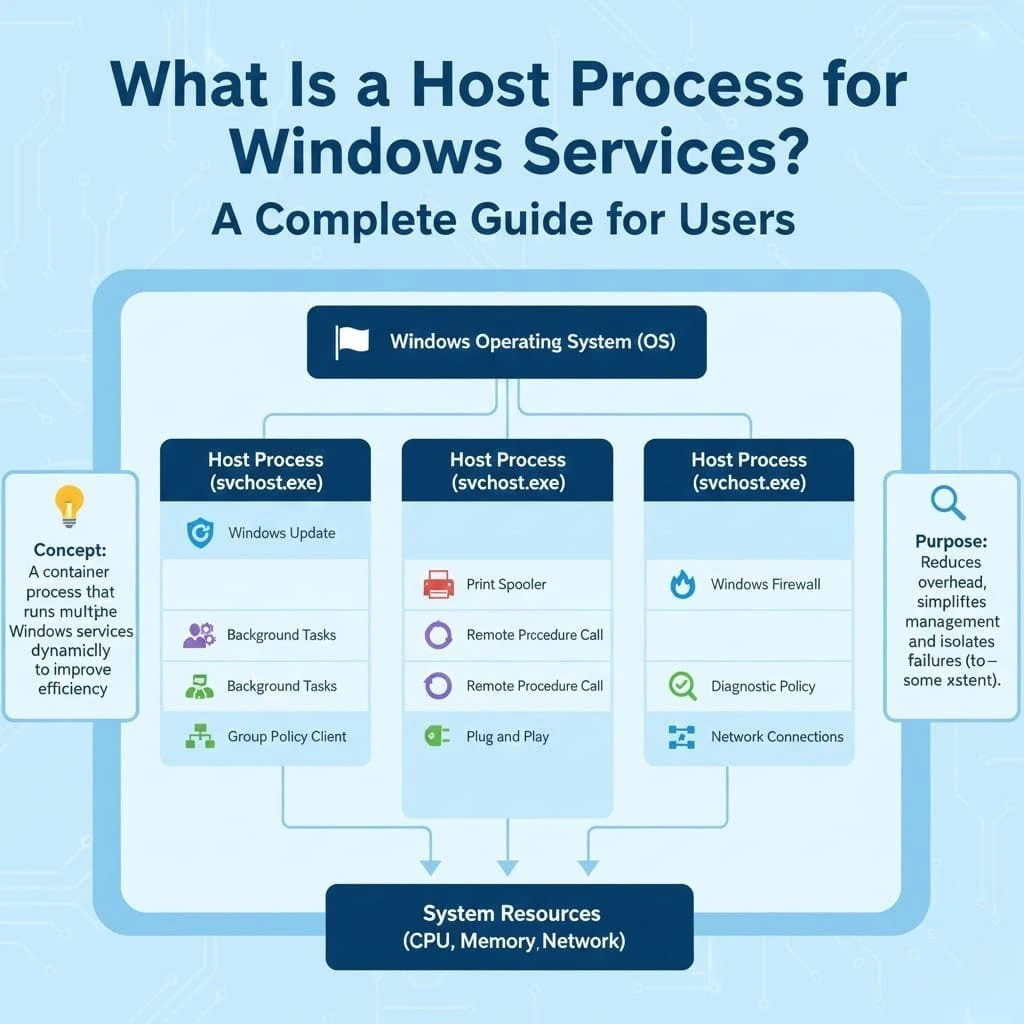

If you use a Windows computer, you may have noticed the Host Process for Windows Services in the task manager. The issue of the appearance of a number of running cases concurrently puzzles a lot of users. Even people regard it as the fear of the virus.
This recommendation helps you understand the Host Process for Windows services. It explains what it is and why your computer needs it.
What are the Host Process Windows services?
Windows services play a substantial role in the system, and they start and manage other Windows services. Background services help with many tasks. They include updates, notifications, network connections, audio support, and system security. This would render windows lacking in the majority of the features.
It is a parent program which loads a group of modules of service. Windows has a modular design. This allows one Host Process to run many services at the same time. It is a stability improvement construction that helps in the prevention of crashing of the system.
The Multiple Host Process Instances Justification
You have several Host Processes that are in operation when you drop down Task Manager. This is completely normal.
1. Better Resource Management
Windows can share memory and processing power well. This happens because other Host Process units can use services. This is so as to get your computer up and running.
2. Enhanced Security
The distortion between various services introduced by windows is to counter the influence of malware or systems corruption. Windows can block suspicious service without affecting the entire system in case it attempts to reach core files.
Windows Services Host Process Overview
The concept of Host Process, you must know in order to gain insight into what it is.
Step 1: Service DLL files are loaded by Windows
Most of the Windows services are of type DLL files. They cannot run directly; therefore, Windows uses the Host Process to start them as such.
Step 2: Granted Background services
Upon loading, the services commence in silent mode in the background. The services help with other important tasks. These include updates, logging in, controlling audio tools, and managing Bluetooth connections.
Step 3: Resource Allocation and Monitoring
The Host Process monitors each service and offers a hassle-free performance. Windows can restart a service without affecting other services. This happens if the service uses too much memory or CPU.
Is there a virus present in the Host Process for Windows services?
The majority of users become concerned when they experience a wide range of processes within the system. However, the Windows services are not a virus, but rather the Host Process. It is also a valid Windows component.
That being said, malware can impersonate such names. The following are the checks that need to be made in order to be safe:
Check the File Location
Original file will be found in:
C:\Windows\System32
If you find another file with the same name in a different folder, it might be a malicious file.
Use Windows Defender
It is also advisable to scan your system with Windows Defender or any other reliable antivirus.
Monitor Unusual Activity
If the process is using too much CPU or memory, it may mean there is an infected service or malware.
Issues Related to Hosted Process
Even though you must have the Host Process, there are cases when you might encounter a problem. The commonest methods of their resolution are they.
1. High CPU Usage
The risk of saturation of the system with some services is one of the threats. You can solve this by updating Windows or uniting the unrelated start-up services.
2. Memory Leaks
Causal memory impairment can be occasioned by driving. The team may update the drivers, and someone may carry out a system scan.
3. Unexpected Crashes
In the event of a Host Process crash to restart your system and Windows troubleshooter.
Windows services- High host use process.
Prepare the following measures in case of the slackening of the system performance.
Update Windows
Go to
Setting windows update check.
This takes the place of the old files and bug corrections.
The other proposed process for disabling them involves disabling the unnecessary startup programs.
To do it, open Open Task Manager, and then, on it, go to the settings and disable applications that you do not need.
4. Run System File Checker
Be an administrator and come in:
sfc /scannow
This command fixes the broken system files.
5. Scan for Malware
Windows Defender is capable of identifying threats which have the highest chances of disrupting the services of the systems.
When the Host Process is of Concern
You should worry only if:
- Host Process cannot be found in the System32 folder.
- It consumes inconceivably huge CPU time.
- Unidentified services deposit there.
- When you introduce some unfamiliar software into your system, it breaks.
In this case, you will need to perform a complete antivirus scan.
Best Practices in the Services of Maintaining Healthy Windows
To keep performance strong, here are some practices that will help ensure smooth operation:
Update Drivers frequently
Updates of drivers available are those that do not conflict with system services and overload them.
- One should not use Party Registry Cleaners.
- These instruments can corrupt system files.
- Keep Windows Updated
- There are regular updates that promote efficiency and reduce errors in systems.
- The applications used should be credible.
- Unknown applications can install malicious services against your authority.
FAQs
1. Why are there so many Host Processes of Windows running?
Ans: There are a number of Host Processes that isolate the services of windows. This enables the system to be more stable and secure as failure of one service will not impact the whole system.
2. Can someone host Process Windows services?
Ans: No. It is a core system component. Any delay would cause the crash and malfunction of the system, and Windows capabilities.
3. Is there security with the Host Process Windows services?
Ans: Yes, it is not malicious in the System32 folder, yes, in case. Install a malware detector, in case you have it on a different system.
Conclusion
To wrap it up, the Host Process of Windows services is, and that would have helped you to run your Windows system easily. Windows services run in the Host Process application. They help keep background processes active. These services also add security and support the system’s basic functions.
The second advantage of updating the systems and checking performance is that it keeps your computer safe and healthy. This helps prevent the unpleasant experience of system issues.