
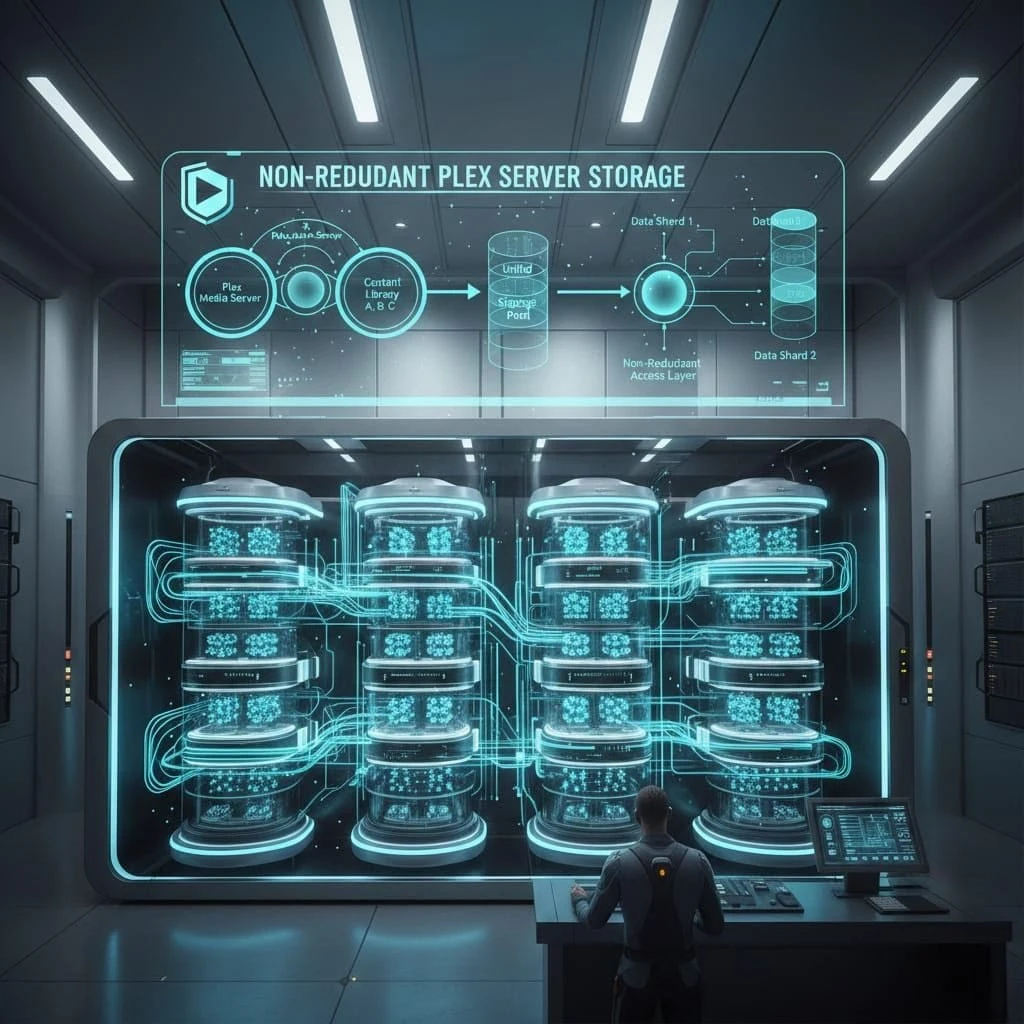

The most popular way to create a personal media server is by using a Plex server. This server can store movies, TV shows, music, and photos.
Using a non-redundant Plex server for storage is highly recommended, especially for beginners. It is simple, cheap, and easy to manage. This type of storage does not need backup or copies of information. Users can store a file on just one drive.
In this guide, we will explain non-redundant Plex server storage. We will look at its benefits and risks. We will also discuss how to manage drive failures properly. This paper examines how Google search engine optimization ensures easy web indexing and ranking.
What Is Non-Redundant Plex Server Storage?
Non-redundant Plex server storage means that users store Plex server media files on individual drives without duplicating data. In a non-redundant storage system, you keep a copy of your data on one hard disk. This is different from RAID or mirrored storage systems, which save copies on multiple hard disks.
To illustrate, when you save movies in a 4TB disk, these movies are present only on the disk. Without a separate backup, you will lose the data if the drive fails.
It is a very popular storage method with home users that operate a media server on a budget or who are new to Plex.
Reasons Why People Use Non-Redundant Storage with Plex Server
The use of non-redundant Plex server storage is a practical reason that is chosen by many Plex users.
1. Lower Cost
These unnecessary storage systems require many drives. This ensures that you do not spend extra money on acquiring non-redundant hardware.
2. Easy Setup
It is not a difficult arrangement. You can just put in the drive in it, add it to your Plex server and begin adding the media.
3. Flexible Expansion
Adding drives is easy. You do not need to put an array back together. You also do not need to worry about compatibility. You can add extra hard drives anytime.
4. Full Storage Usage
With non-redundant storage we do not waste any drive capacity. One 4TB hard disk provides you with the entire 4TB of media storage.
How Does Non Redundant Plex Server Storage Work?
In this configuration, you implement the Plex server on a PC, NAS, or dedicated server. Someone stores the media files in one or several independent drives.
Each drive:
- Works separately.
- Sorts different media folders.
- Not correlated with the other redundancy drives.
Where one of those drives fails, the drive affects only the data. The remainder of your media server also works as usual.
Drive Failure: The Greatest Threat
The largest drawback of non redundant Plex server storage is a drive failure.
What Is the Meaning of A Failure of a Drive?
When a drive fails:
- Plex is no longer able to read anything in that drive.
- The Plex library deletes instances of films and programs.
- Data recovery can or cannot be excessively costly.
Drives in most instances crash unexpectedly especially the old and frequently used drives.
Prevention of the Risk of Drive Failure
Non-redundant storage cannot fully prevent data loss. However, it can reduce the risk by using a careful approach.
1. Use Quality Hard Drives
Select trusted brands that are utilized to serve media server and NAS. Take not low or unguarded impulses.
2. Monitor Drive Health
On a regular basis health check drives are conducted with the SMART monitoring tools. It may also make you modify a drive with some level of effort in case there is some prior notice.
3. Keep External Backups
It is not just extra storage. A copy saved on an external drive or in cloud storage is highly recommended.
4. Replace Old Drives
A drive that is already in functioning should be changed before a drive malfunctions.
The Possibility of Adding Drives to a Non-Redundant Plex Server
A key benefit of non-redundant Plex server storage is that addition of drives is easy.
How Adding Drives Works
- Installation of a new hard disk in the system.
- Format the drive.
- Create a media folder.
- Introduction into plex library.
One does not need to re-create data or even relocate existing files.
Example
One 4TB movie drive initially. Then, in case of storage space overflowing, you can insert another 4TB drive of TV shows. Plex operates the two drives separately.
What If a Drive Fails?
When a drive fails:
- Plex shows missing files.
- The library is auto- updating.
- Other motives are not interrupted.
In case of the breakdown of the drive and loss of data, you can:
- Re-rip or re-download media.
- Lastly, updating backup material.
- Install an additional failed drive and continue.
Non-redundant storage embraces the fact that the failure of drives may occur, but causes damage to only one drive.
Are You Right to Use Non Redundant Plex Server Storage?
The type of storage will best suit in:
- Home Plex server users.
- Budget-conscious setups.
- Such users use this tool when they may modify their media.
- The ones who like to be talkative.
It may not be suitable if:
- Your media is irreplaceable.
- You need 24/7 uptime.
- You desire an extent of the protection of the data as much as possible.
In this case optional storage can be better.
Best Practices on Non Redundant Media Server Set Up
The best practices to use to have a stable media server with non-redundant storage comprise:
- Organize media by drive.
- Label drives clearly.
- Complete a list of in-store documents.
- Backup important files
- Avoid putting OS and media in the same drive.
You can use the steps in the process of maintaining performance and minimizing risks.
Plex Server Benefits on Performance
Non-redundant Plex server storage can be a great performing server due to:
- No parity calculations
- No mirroring overhead
- Direct read access
This will also lead to a reduced scan time and superior play back particularly with the high bit rates.
Final Thoughts
Non redundant Plex server is an easy, scalable, and affordable method of creating a personal media server. While there is a risk of losing motivation, good planning, regular check-ins, and third-party data protection can help a lot.
The best trade-off for performance, cost, and user ease is non-redundant storage. This is especially true for Plex users at home. When you understand the dangers of inaction and keep your intentions in check, there will be little wear and tear.