

How Long Does Cloud Migration Take?pOne of the most common questions businesses ask when planning digital transformation is how long does cloud migration take. It is not the best solution for all organizations.
Migration depends on many variables. These include infrastructure size and application complexity. They also include compliance needs and cloud adoption strategy. There are migrations within some few weeks and there are migrations consuming several months and even more.
Knowledge of migration times can enable organizations to make realistic expectations, proper resource allocations and reduce disruption. Cloud migration is not simply about moving applications and data from data centers to cloud environments. It is an orderly cloud migration plan that incorporates planning, testing, implementation and optimization of the post migration.
What the Cloud Migration Means and Why It Matters?
Cloud migration is the process of moving apps and data from on-premise data centers or older systems to the cloud. This migration lets organizations use cloud-based resources to improve scalability, flexibility, and performance. Cloud migration also supports innovation because organizations can build cloud-native solutions that are more efficient and agile.
Cloud has such advantages as optimization of costs, enhanced reliability, enhanced disaster recovery and collaboration. Nevertheless, to become a successful cloud customer, the organization should be careful and deliberate during migration.
Influential Factors that Influence the Migration Times
It has a number of factors that affect the timeline of cloud migration. The number of involved specific applications is one of the most important aspects. It takes a few weeks to migrate a small number of simple applications, and may take months to migrate hundreds of complex systems.
The other is the status of available infrastructure. Even older legacy system environments frequently need extra preparation, modernisation or re-architecture prior to migration. Industry rules and compliance needs can also extend timelines, since extra safety steps and audits may be required.
The migration strategy selected also has an effect on timing. Some organizations use lift and shift, whereas they redesign applications to be cloud native. The techniques possess varying degrees of demand and time.
Learning About the Various Cloud Migration Strategies
One of the fastest migration processes is Lift and shift. It entails migrating applications and data to the cloud space with changes. Migration times tend to be less since there is no need to redesign something significant in this approach. But lift and shift is not necessarily taking advantage of cloud capabilities.
The more advanced methods include the adjustment of applications or their reconstruction to leverage cloud native capabilities. These are methods that are more likely to be long lasting, have high performance and are scalable. The choice between speed and optimization plays a major role in determining how long cloud migration takes.
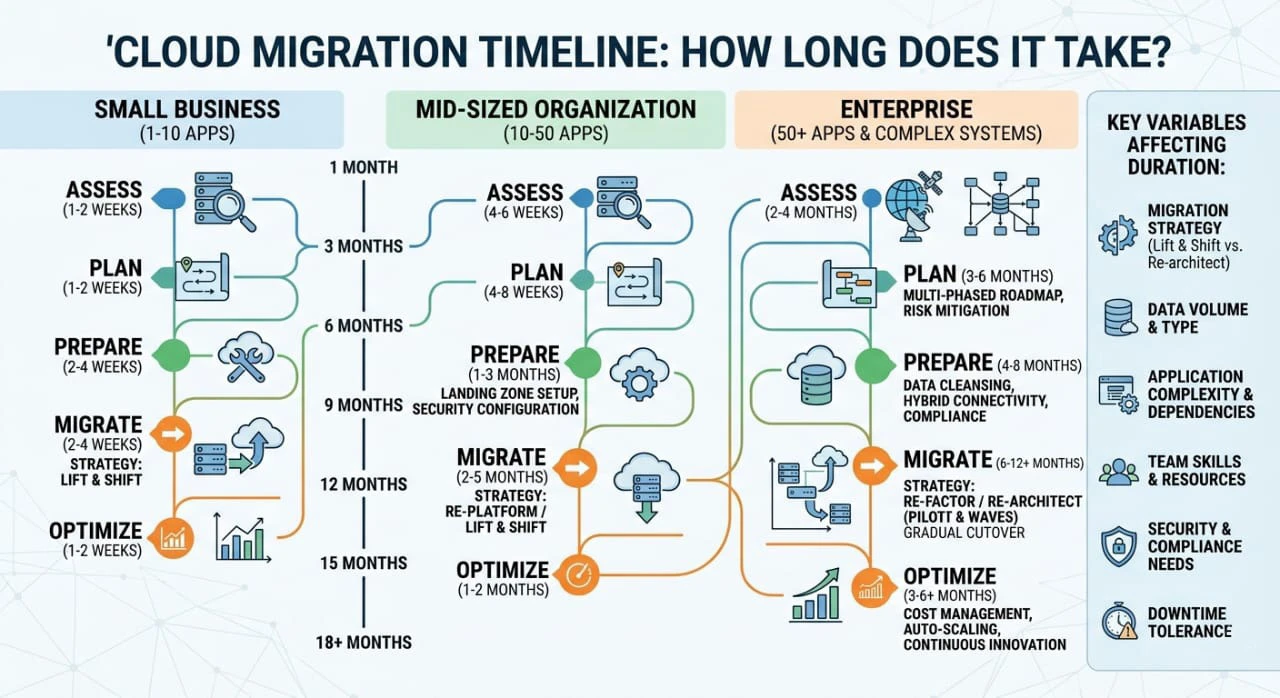
Common Stages of Cloud Migration Timeline
The cloud migration process is usually divided into several phases.
Planning and Evaluation
In this phase, organizations are used to analyze the existing applications and data, determine dependencies, and to set goals. The phase can be a couple of months or a few weeks based on complexity.
Preparation and Design
This involves the installation of cloud infrastructure, architecture, and security. We also produce testing environments at this phase.
Execution
Applications and data are moved according to the migration plan. This step takes place in a few weeks up to several months depending on the size and complexity of the task.
Post Migration Optimization
They consist of performance tuning, cost optimization and data integrity assurance. The main migration can be beneficial, but ongoing refinements are interim improvements during long-term cloud adoption.
Small, Medium and Large Organization Timelines
Cloud migration can be completed in a period of between one to three months in the case of small businesses that have few applications and have straightforward infrastructures. These organizations often adopt simple rehosting or lift-and-shift strategies.
Medium-sized organizations with many departments and moderate complexity may need three to six months. This schedule lets them test, verify, and train adequately.
Enterprises with complex, tightly controlled systems and multiple data hubs may take between six and eighteen months, among others. Teams usually reduce the risks of these projects in stages.
The Role of Security and Compliance
Conflict and control are also necessary throughout the migration. Organizations need to make sure they set up data protection, identity management, and access controls appropriately. Compliance requirements might also entail some extra documentation, audits and testing that can increase migration durations.
Nevertheless, saving time at migration in terms of security mitigation minimizes future risk and facilitates cloud success.
Data Accuracy and Data Integrity
Migration is an important aspect in ensuring that there is accuracy in the data. However, there should be data validation before and after migration in order to ensure that nothing is lost or corrupted. This verification will come as an extra time cost, but the cost is needed to ensure the continuity of business.
This can also be done by testing to verify the use of applications and data in clouds. Failure to do this may cause problems of operation once migration has been done.
Post Migration Activities
Post migration activities are just as important as the migration itself. Organizations are forced to check the performance, most economically using resources and changing configurations. Training employees to use new cloud based tools is also part of post migration.
The activities are not always included in the primary migration timeline, but they are very important in accomplishing the long term success.
How to Minimise Cloud Migration Time?
The best method of reducing time spent in migration is proper planning. The challenge of making a solid evaluation as well as picking the appropriate migration strategy and automation tools would greatly accelerate the process.
Cooperation with cloud professionals is another way to eliminate mistakes and delays. Effectiveness is boosted with effectiveness as a result of clarity and harmony of stakeholders.
Cloud Migration Realistic Expectations
One should also realize that cloud migration is not an event. It is an adventure that goes on because of the change in technology. Asking how long does cloud migration take should be followed by asking how to ensure long-term cloud success.
Those organizations that aim at speed alone fail to consider optimization and security. The combination of time and quality is the most effective solution that provides the best results.
Conclusion
So, how long does cloud migration take? The response will vary depending on the size of organization, complexity of application, migration strategy, and compliance criteria. Minor migrations can take weeks, whereas enterprise-wide projects can take more than a year.
Through the knowledge of the cloud migration process, appropriate strategy and emphasis on security and planning, business can have the ease of transition, and prolonged cloud conversion. Cloud migration is a future investment and when approached appropriately, it yields more agility, scalability and innovation.