
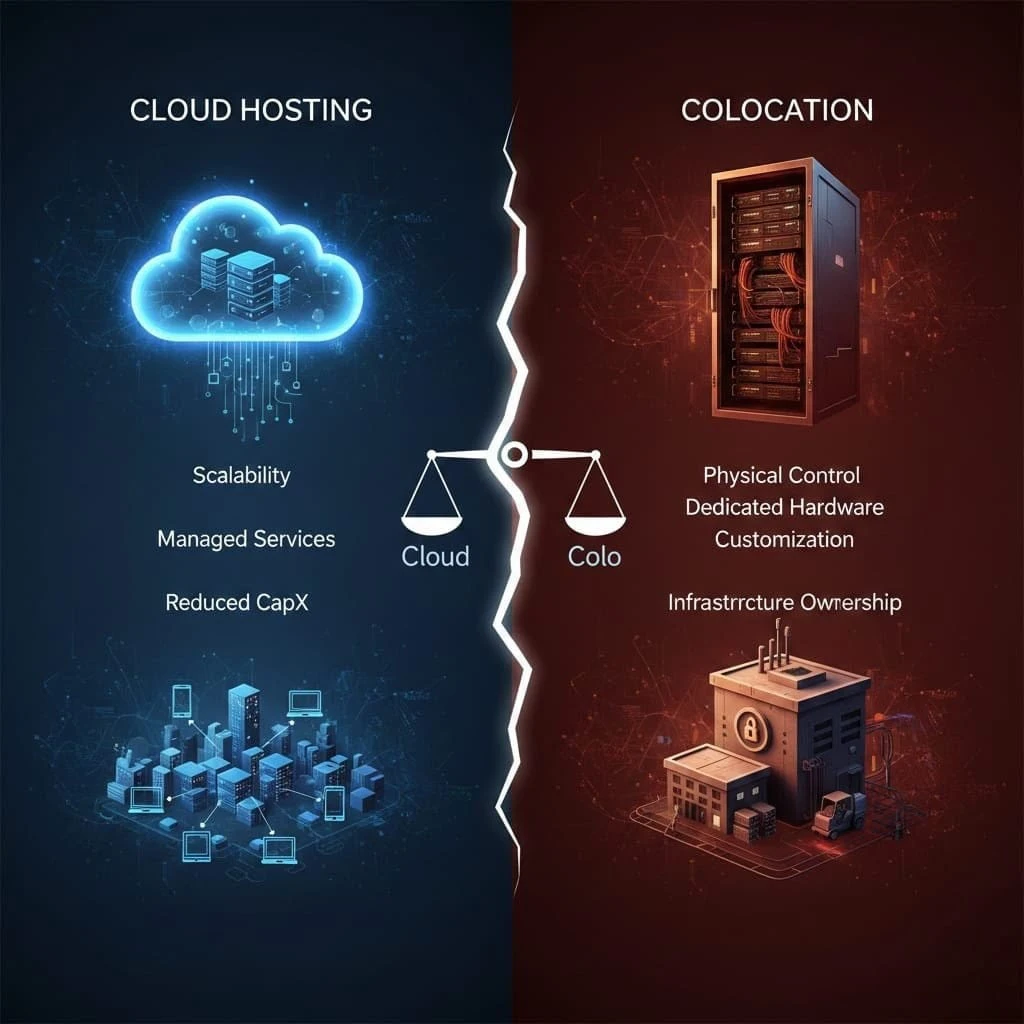

JSelecting an appropriate IT infrastructure is a decisive move of contemporary organizations. Two popular options dominate the conversation today: cloud hosting vs colocation. The two models are equally reliable when it comes to computing resources. However, they differ a lot in cost, control, scalability, and security.
Understanding colocation and cloud helps businesses make better technology choices. This is important for long-term plans, compliance rules, and budget limits. The article gives a detailed and optimized search engine meaning. It helps you find the best solution for your needs.
What Is Cloud Hosting?
Cloud hosting is a type of cloud computing. It offers services like servers, storage, and networking over the internet.
Cloud services come from third-party vendors. They help businesses use services without needing their own physical infrastructure. Huge data centers store such services, and assigned users can access them anywhere.
The vast majority of companies begin with the public cloud, where they share infrastructure with a number of customers. The cloud provider takes care of storage computers and even upgrades in software and updates in security. This makes cloud hosting a great choice for organizations that want flexibility, speed, and little hardware responsibility.
Cloud hosting has many benefits. These include easy scalability, simple deployment, and access to advanced managed services. These services include databases, analytics, and artificial intelligence tools. The companies pay per use, and thus cloud solutions are very cost effective with dynamic workloads.
What Is Colocation?
Colocation is a type of hosting. In this setup, companies place their own servers and storage devices in third-party colocation facilities.
Companies rent space in a professional data center. This is better than building their own data center. A data center needs cooling, network connections, and security.
When organizations choose colocation, they maintain full control of their hardware. They also benefit from enterprise-level data center environments. Colocation services are for businesses that need reliable performance and customization. They are also important for companies with strict compliance needs.
Cloud hosting virtualizes the resources by default, unlike colocation. It allows companies to run their own clouds or hybrid setups while still accessing their equipment directly.
Cloud Hosting vs Colocation: Core Differences
Understanding the core differences between cloud hosting vs colocation helps clarify which option suits specific business needs.
Infrastructure Ownership
In cloud computing, the provider owns and controls all the infrastructure. The enterprises merely hire the computing environment. Under colocation, the company would own the servers and the data center would make the physical environment.
Scalability and Flexibility
Cloud computing is instantly scaled. Startups and rapidly developing companies can increase or decrease their resources in a matter of minutes. Colocation scaling is not fast because it requires the acquisition of new equipment and installation.
Cost Structure
Cloud services are based on a pay as you use platform hence cost saving at peak workloads. Colocation is cheaper over time. It needs an initial investment in servers and works best for stable, long-term operations.
Management and Maintenance
The cloud providers offer large scale managed services, maintenance, updates and monitoring. Under colocation, IT teams are still in charge of administration of hardware unless they buy extra managed services.
Physical Protection and Security
One of the key aspects in the colocation vs cloud is security. Cloud vendors use robust online protection, such as encryption, firewalls, and incessant surveillance. Nevertheless, organizations that handle sensitive workloads store information in common environments where it can raise concerns.
Colocation facilities are very strong when it comes to physical security. They are utilizing biometric access controls, surveillance systems, security guards, as well as limited entry to designated users. Companies dedicate hardware, giving them more control over security configurations.
In companies with high compliance standards, colocation can be clearer. It gives companies better control over data storage and access.
Compliance Requirements and Regulatory Needs
Some of these industries like finance, healthcare and government are on tight compliance rules regarding data storage and processing. Cloud computing providers offer compliance certifications, but a shared environment might not always meet regulatory audit requirements.
Colocation enables organizations to tailor infrastructure and policy of security to comply with regulatory provisions. This flexibility makes colocation services attractive to businesses that need full control over their data.
Specifications in Performance and Reliability
Cloud computing resources distribute the workload over more than one server providing a high degree of availability and redundancy. This enhances good business continuity and disaster recovery alternatives.
Colocation with data centers that feature redundancy in electric power, cooling, and network also enhances high reliability. With the right planning, you can use Colexions to achieve significant performance and reduce downtime.
Business Continuity and Disaster Recovery
Cloud hosting eases the process of disaster recovery because it copies the data to different areas. This results in quick and automated recovery in most instances.
In colocation, disaster recovery planning relies on the architecture of the company. Colocation facilities provide strong infrastructure. However, organizations must create their own backup and failover systems or use extra managed services.
The Case of Determining When Cloud Hosting is a Good Idea
Cloud hosting is ideal for:
- New and small companies.
- Working on a short term basis.
- Companies that require fast implementation.
- Teams with limited IT staff.
Cloud computing is a strong choice for innovative environments. It allows for quick expansion and offers many cloud services.
When to Choose Colocation
The choice of colocation is appropriate in cases where:
- You have to have total control of hardware.
- Workloads are predictable and constant.
- The strictness of compliance requirements is high.
- The cost optimization on a long-term basis is under consideration.
Colocation services are a good choice for businesses that want high performance. They are often cheaper than building a data center.
Between the World and Me Hybrid Approaches
A great number of organizations are currently mixing the two models. One example of a hybrid approach is to use cloud services for scalability and innovation. For sensitive or mission-critical systems, colocation is a better choice. This strategy is flexible, secure and cost effective.
Final Thoughts
The decision between cloud hosting vs colocation depends on your business size, budget, security needs, and growth strategy. Cloud computing is the most flexible and intuitive and colocation is the one that provides control, performance and compliance.
When you carefully assess your business goals and technical needs, you can choose the right infrastructure model. You may also combine different models to ensure your long-term success in our digital world.