
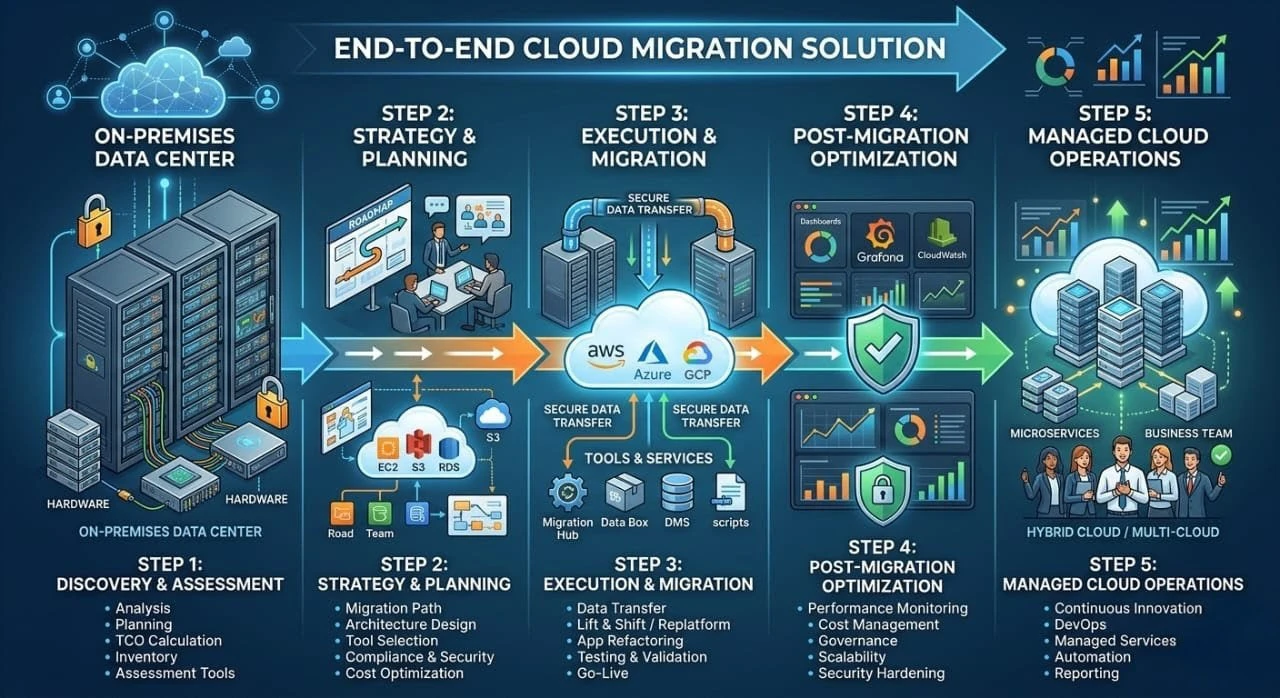

Today, businesses are constantly pressured to modernize their IT infrastructure, decrease the cost of operations, and provide faster and more reliable digital experience. End-to-End Cloud Migration Solutions move organizations from legacy or on-premises systems to a secure, streamlined cloud—without gaps or risks.
This paper disaggregates precisely what end to end cloud migration solutions entail, why they are better than fragmented solutions and why they provide business value at each step of the process.
What are End to End Cloud Migration Solutions?
Cloud migration refers to the process of relocating the digital resources of an organization, such as applications, databases, workloads, and infrastructure, off-premises or off of legacy systems, to cloud platforms. End to end implies that this process is approached on a holistic basis, as opposed to each phase being treated as a discrete project.
Disjointed migration strategies – where assessment is done by one team, execution by another, and nobody owns optimization are always associated with cost overrun, performance problems, and security holes. End to end cloud migration solutions help avoid these issues, by offering a unified, ongoing interaction that keeps accountability and momentum through all phases.
Phase One: Development of Discovery and Migration Plan
Any successful migration starts with an elaborate migration plan. End to end cloud migration solutions perform a comprehensive discovery process-inventorying all servers, applications, databases and network dependencies throughout your current environment, before a single workload is migrated.
This discovery phase will give you a full picture of what you need in your cloud environment, what workloads of the legacy systems can be rehosted, replatformed, refactored, or retired, and a sequenced migration roadmap to accomplish this with business-critical systems prioritized accordingly.
Success metrics are also established at the outset by a robust migration plan, including performance goals, cost goals, availability goals, and compliance milestones, ensuring that all later stages have goals to achieve.
Phase Two: Cloud Platform Choice and Architecture Design
The choice of the appropriate cloud platforms to suit your workload mix is one of the most significant choices in any migration. End to end cloud migration providers assess your needs against the big three — AWS, Microsoft Azure, and Google Cloud and then prescribe the best architecture based on the performance requirements, geographic coverage, existing technology investments and budget.
A multi cloud strategy is adopted by many enterprise organizations, which distribute workloads to two or more cloud platforms to prevent a vendor lock-in, to better respond to the costs of certain types of workloads, and to enhance resilience. Multi cloud architectures are not only created by accident: end to end cloud migration solutions make sure that there are smooth integrations between platforms, coherent security policy, and the ability to have a single central view of all the environments.
The principles of cloud native architecture are implemented wherever it makes sense – containerization, microservices, serverless computing, and managed database services are used instead of monolithic legacy systems design, which will provide a more scalable operation and lower the long-term operational costs.
Phase Three: Migration Implementation and Minimizes Risk Framework
Most of the self-managed migrations face severe issues in the execution. In the absence of the appropriate tools, sequencing, and expertise, migration implementation brings about downtimes, data loss, and performance decline. End to end cloud migration solutions are implementing a structured reduced risk framework during implementation – through continuous replication technology, keeping the source and target environments in sync, reducing cutover windows to minutes instead of hours.
Migration waves are ordered so as to migrate the less risky, non-urgent workloads before tools and processes are verified and migration critical systems are migrated. This strategy minimizes risks on each step as it creates trust and solves any unforeseen problems on workloads whose business impact can be handled.
Migration tools are automated to do most of the heavy tasks such as workload discovery, data replication, server images conversion, and cutover, but skilled engineers are to watch over each process and step in as soon as anomalies are detected.
Phase Four: Cloud Services Set up and Smoothing Integrations
It is half the battle to move workloads to the cloud. The proper setup of cloud services storage, networking, identity management, monitoring and security can make or break your cloud environment; it will work as intended or turn into a costly, unreliable nightmare.
End to end cloud migration solutions include the entire configuration of cloud services as part of the engagement, including the proper segmentation of networking, access controls that adhere to the least-privilege principles, data encryption at rest and in flight, and logging of the activity required to achieve compliance and troubleshooting.
The smooth connections between your cloud infrastructure and the current on-premises applications, third-party SaaS applications, and partner APIs are defined and tested at this stage. One of the most common causes of post-migration business disruption is integration failures – by managing them upfront in a well-designed end to end engagement, the expensive fire-fighting that defines such poorly-planned migrations can be avoided.
Phase Five: Business Continuity and Disaster Recovery
Disaster recovery is not a side option to cloud migration service, it is part and parcel of a responsible cloud migration service. End to end cloud migration solutions incorporate the design and implementation of disaster recovery within the migration rather than as a distinct project that is planned to be undertaken at a later stage.
Cloud-based solutions enable disaster recovery on enterprise level to organizations of any size. Managed cloud services provide geographic redundancy, automated failover, point-in-time database recovery, and cross-region replication, capabilities that cost millions to replicate on-premises, at a fraction of the cost.
Recovery Time Objectives (RTO) and Recovery Point Objectives (RPO) of all workloads are end to end cloud migration solutions that define the migration plan, and architect the cloud environment to achieve those requirements. Disaster recovery setups are not assumed to be valid until something goes wrong in production, they are tested before go-live.
Cost Savings: The Financial Case of End to End Solutions
Cost savings are one of the main forces behind cloud migration – however, in many cases, migrations are done poorly, creating the reverse effect. Those that migrate without adequate planning regularly overuse cloud resources, pay idle services, and experience technical debt that incurs costs as time goes on.
End to end cloud migration solutions are providing real cost savings by rightsizing recommendations, reserved instance planning, and FinOps practices that are integrated throughout the engagement.
Post-migration cost optimization reviews make sure that cloud costs remain consistent with real consumption, removing waste and constantly enhancing the cost efficiency of your cloud infrastructure. When organizations engage the services of established cloud migration suppliers, they always realize a 30-50 percent savings of their infrastructure costs in the first year of migration.
The Reasons Why Legacy Systems Should be Given End to End Attention
The most difficult part of any migration is the legacy systems. Older applications may be hardconfigured and undocumented, old-runtimes based, and may have integrations that were never built to work on a cloud environment.
End to end cloud migration solutions are solutions to legacy systems based on a suite of automated discovery tools that chart all dependencies, compatibility testing that detects problems prior to migration as opposed to during migration, and application modernization services that refactor or replatform legacy workloads to execute effectively on cloud native infrastructure.
Leaving legacy systems unoptimized: Moving them to the cloud without optimization will mean that a significant portion of the performance and cost savings advantages of migration are lost. End to end solutions are built in such a manner that legacy modernization is not an afterthought.
Conclusion
End to end cloud migration solutions are the distinction between a migration that does what it promises and one that brings more issues than solutions. Spanning all stages – migration plan creation to modernization of legacy systems, multi cloud architecture design, seamless integrations, disaster recovery, and continuous cost savings optimization – end to end cloud migration solutions offer businesses the holistic, interconnected approach that fragmented projects can never offer.
The cloud environment your company requires to compete is affordable – the trick here is to collaborate with a cloud migration service that manages the whole process of migration to the cloud.