
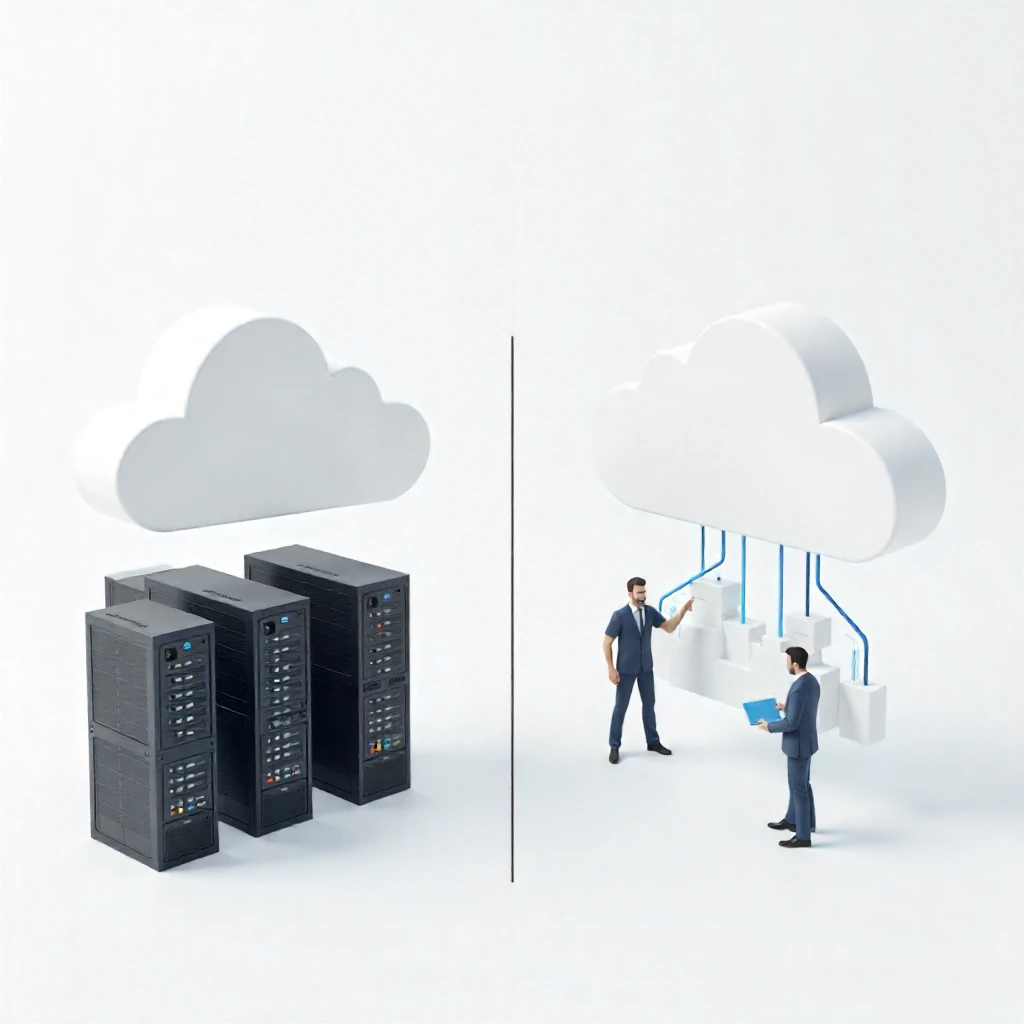

No decision is more important for your business than where and how to host your data and applications. This is crucial because of the digital infrastructure. You can host your services in two ways: in-house or through cloud hosting.
The choice you make impacts several factors. These include your costs, security, scalability, and support for remote work.
This guide will explain the pros and cons of in house hosting and cloud based hosting. This will help you make a smart choice for your business.
In House Hosting
In house hosting, or on-premises hosting, means using your own servers. Your business owns and manages these servers at your location. You have full control of the hardware, software, and data without an external third-party vendor.
The Benefits of In House Hosting
- You have full control and customization of your server. This includes choosing the hardware and software settings. This suits well for businesses with special requirements or those dependent on legacy systems that require special arrangements.
- Direct Data Security: You maintain physical control over all critical data, and you store it within your walls. In industries where data security is very important, having direct control will be very helpful.
- No Internet Dependency: You do not need to connect to the Internet to access data. You can keep working even if your internet service goes down. You will still have access to the local network.
The Cons of the In House Hosting
High Start-up Cost: Setting up a server room is costly. It involves buying hardware, software licenses, and networking equipment. You will also require a special room with good cooling and a lock-up.
Continuous Maintenance and Personnel: All maintenance, updating, and repairs are the responsibility of your business. This will need a qualified internal IT department whose wages and continual training are an additional cost of ownership.
Low Scalability and Disaster Recovery Risk: Scaling up is a slow and expensive operation, which requires buying new hardware. Local server disasters, like fires or floods, can easily destroy information on in-house servers. To protect your data, invest in a strong off-site backup system.
Cloud Based Hosting
Cloud based hosting uses virtual servers in remote data centers. You pay as you consume, as opposed to purchasing hardware, but rather renting resources and accessing them online.
The Benefits of Cloud Based Hosting
- Better Scalability and Flexibility: You can easily add or remove storage, processing power, and memory as needed. It is ideal when it comes to seasonal business or when the business is growing at an alarming rate.
- Pay-As-You-Go Savings: Cloud computing works on a subscription or pay-as-you-go model. This model removes the need for large upfront costs. This makes IT costs a predictable cost of operation.
- High Accessibility and Built-in Redundancy: Authorized users can access systems and data from anywhere with an internet connection. This supports remote work. Cloud providers also create data in geographic locations, making the business not collapse even when one location goes offline.
The Cons of Hosting in the Cloud
Recurrent and Unpredictable Costs: They may appear inexpensive at first, but the constant subscription cost will increase with time. When people do not monitor the use of resources carefully, they can also experience unpredictability in costs.
You rely on the internet and a working network. They help you find information and use your apps. When your provider goes offline, your business activities will fall to a crawl.
Limited Control and Vendor Lock-In: You lose control over the physical infrastructure and physical maintenance schedule. Changing the provider may also be arduous and costly, and this would result in vendor lock-in.
Security: Perception vs. Reality
There is a perception that in-house hosting is more secure in nature. This is, however, not always so. Even if you are in control, keeping a server running requires careful attention, skill, and expensive equipment.
Big cloud providers spend a lot on advanced security. They use AI to detect threats and follow industry standards. This often gives them a stronger defense than most businesses can manage on their own.
Performance and Uptime
- In-House: It is predictable, but limited to your local network. You cannot guarantee uptimes unless you spend money on redundancy systems.
- Cloud: Content delivery Networks (CDNs) can help to optimize performance around the globe. Service providers usually have service level agreements (SLA) with 99.9 per cent uptime guarantees that are very reliable.
When it comes to business, the right solution to your needs. The optimal hosting solution is completely reliant on the unique business requirements, resources, and objectives.
Choose In House Hosting If
- Your company is in a very regulated environment and requires direct data control.
- You handle fixed workloads and do not need to scale them regularly.
- You possess the capital to make an initial investment, and you can afford a committed, professional IT department.
Select Cloud Based Hosting When
- You have a business with a fast-growing demand or a volatile demand.
- You are not keen on huge initial expenses and want to have certain annual expenses.
- Your employees are either remote or hybrid and must work in various places.
The Hybrid Model: The Best of Both Worlds?
A hybrid cloud model combines in-house and cloud solutions. It is becoming popular with many businesses.
This will let you store sensitive information and old applications on-site. You can also use cloud benefits to support other tasks, like web applications or a development environment. It is a great plan of a slow transition to the cloud or to strike a balance between control and flexibility.
Conclusion
No universal solution exists in the debate on in house vs cloud based hosting. In-house hosting is the best choice. It gives firms with stable needs and enough resources great control. Conversely, cloud-based hosting offers unmatched agility, cost-saving and availability to expand on or dynamic businesses.